When you are driving a car, you need to have a comfortable ride. You would also prefer being in control when turning or driving on rough roads. It is here that your car suspension system comes into play. It joins your car to the wheels and it shock absorbs the road.
In this guide you will come to know about various types of car suspension systems using plain words. At the end you will see clearly which of the systems is the best one for your needs.
What is a Car Suspension System?
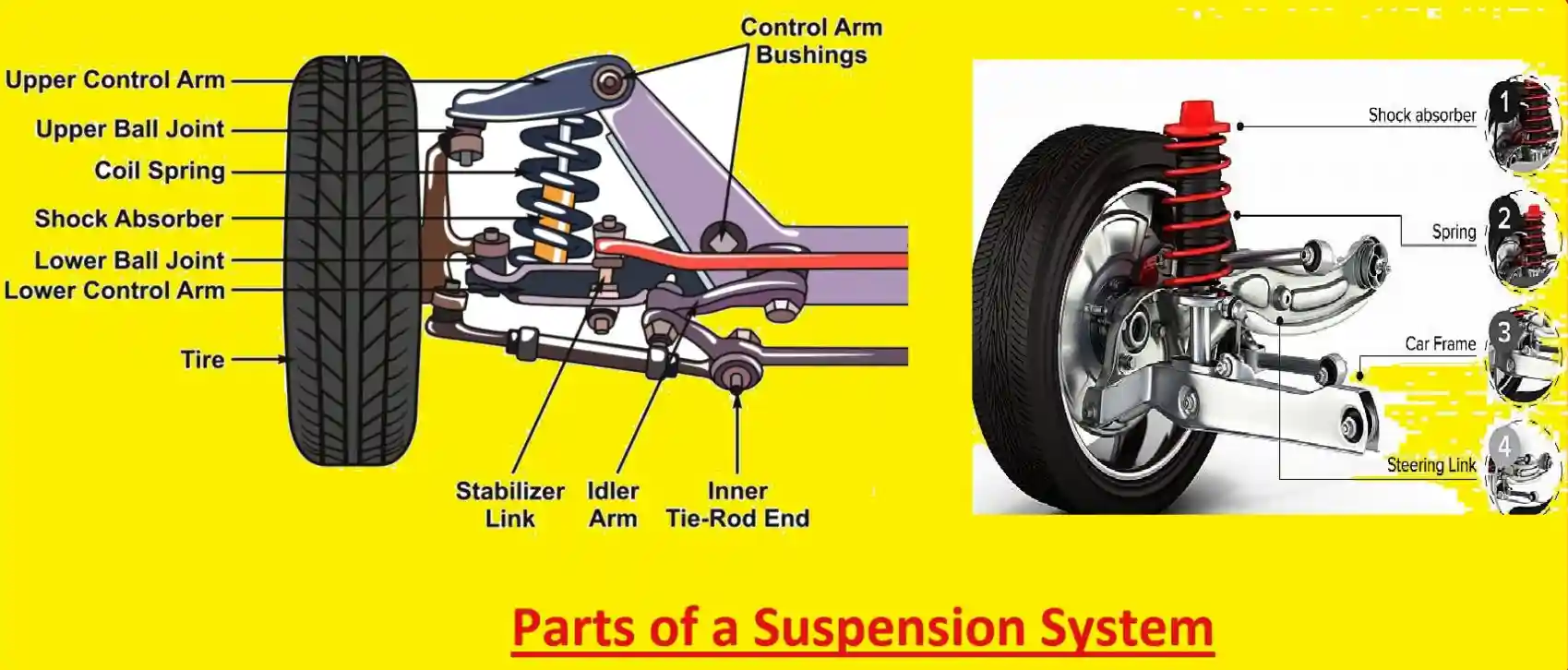
A car suspension system is a system of components that attach your car body to the wheels. It contains springs, shock absorbers and linkages.
Its main job is simple:
- Absorb bumps and shocks.
- Stay in touch with the road with your tires.
- Ride you a smooth and steady ride.
Without the suspension, all the bumps on the road will be very unpleasant.
Why Choosing the Right Type of Car Suspension System Matters
The selection of the best suspension system is one of the differences that matter when it comes to driving.
Here’s why it matters:
- Better Comfort: You can experience fewer bumps on the uneven roads.
- Contrôle amélioré : You can turn your car better.
- More Safety: Tires remain in touch with the road.
- Smart Buying Decision: Assists you in choosing the correct automobile.
Quick Comparison of All Car Suspension Types
| Suspension Type | Confort | Coût | Complexité | Idéal pour |
| MacPherson Suspension | Moyen | Faible | Simple | Daily driving |
| Double Wishbone Suspension | Haute | Haute | Complex | Performance |
| Multi-Link Suspension | Très élevé | Très élevé | Very complex | Luxury |
| Trailing Arm Suspension | Moyen | Faible | Simple | Compact cars |
| Air Suspension | Très élevé | Très élevé | Complex | Premium cars |
| Solid Axle Suspension | Faible | Faible | Simple | Heavy-duty |
| Torsion Beam Suspension | Moyen | Faible | Modéré | Budget Cars |
| Leaf Spring Suspension | Faible | Faible | Simple | Trucks |
| De Dion Suspension | Moyen | Moyen | Modéré | Niche/Performance |
Main Types of Car Suspension Systems
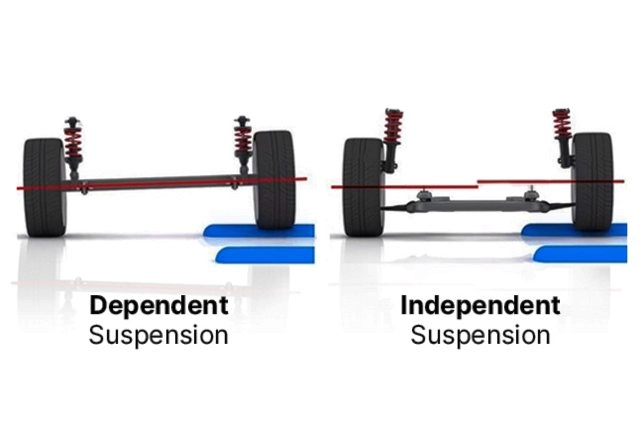
Suspension systems are of two major kinds:
- Independent Suspension
- Dependent Suspension
We should know them in some detail.
Independent Suspension Systems Explained
Qu'est-ce que Independent Suspension?
Under this system, the wheels are fitted to the chassis in such a manner that they can swing vertically without having any influence on the other wheel in the same axle. When one wheel rides over a bump, the other wheel will remain in balance, keeping a contact patch of a flat tire on the road.
This gives you:
- Better Comfort: Vibration at roadways is confined to a single side.
- Better Handling: Times are improved with contact with the road.
- Smoother Driving: Smooth driving is caused by less unsprung weight, which causes the car body to bounce less.
Pro Tip
Independent suspension enhances suspension of tires on uncertain roads. This aids your car in remaining stable when taking a turn and braking suddenly.
MacPherson Suspension
How It Works
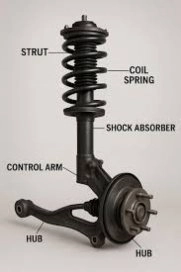
It employs only one vertical strut, which is a combination of a shock absorber with a coil spring. The steering is also pivoted at this strut so it is a very space-efficient design.
Key Components
- Strut: This is a structural element that houses the damper.
- Coil Spring: Bears the weight of the vehicle and has an impact-absorbing property.
- Bras de commande: One lower arm, which joins the frame to the hub of the wheel.
Avantages
- Simple Design: This design designates fewer parts, which allows more cabin and engine room.
- Low Cost: It is now cheaper to produce and put together.
- Simple Maintenance: The Majority of the components are conveniently available.
Les inconvénients
- Not Very Good at High Performance: It may result in minor alterations in the angle of the wheel (the camber).
Idéal pour
- Using cars (Hatchbacks and Sedans) in everyday life.
- Budget-friendly vehicles.
Expert Insight
This is the most widespread suspension of the modern cars. It has the benefit of saving space and therefore it assists the carmakers in designing smaller engine bays.
Driving Feel
You are getting a good ride with reasonable comfort but not that sporty.
Double Wishbone Suspension
How It Works
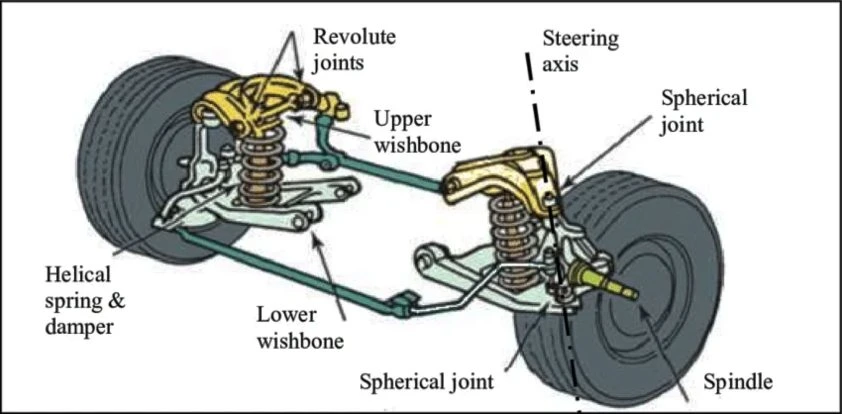
It depends on two A-shaped arms (upper and lower) in order to control the rotation of the wheels. The wheel is nearly vertical due to the two arms so that even when a car is in a turn, the wheel is almost vertical.
Key Components
- Upper Arm: The upper arm has the smaller wishbone.
- Lower Arm: The bigger wishbone is on the bottom.
- Shock Absorber: It is typically fitted diagonally through the arms.
Avantages
- Better Handling: Exceptional high-speed cornering.
- Good Road Grip: This gives the tire the maximum footprint on the ground.
Les inconvénients
- Expensive: Parts and precision engineering cost.
- Complex Design: Under the wheel well, a lot of space is occupied.
Idéal pour
- Sports cars.
- Performance cars (such as formula 1 or sport luxury grand tourers).
Additional Info
This is a system that keeps the tire on the road during turns. This enhances turning and makes tires less worn out.
Driving feel
You get more control, especially when it is fast in driving or when the turning is sharp.
Multi-Link Suspension
How It Works
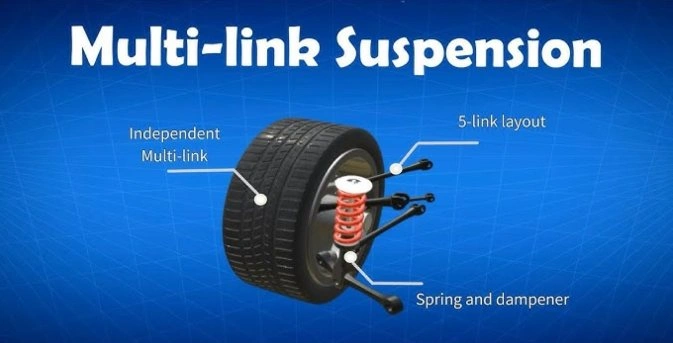
It is the most advanced system, as it controls the wheel using three or more links (arms) and it controls the wheel at various angles. This enables the engineers to tune the reaction of the wheel to the bumps as well as to the side-to-side forces.
Key Components
- Multi-links: A set of rods and arms (typically 3 to 5).
- Springs: Normally not attached to the dampers.
- Dampers: Shocks with high levels of precision.
Avantages
- Very Smooth Ride: Leading vibration isolation.
- Excellent Control: This has the ability to steer sharply and yet provides comfort.
Les inconvénients
- High Cost: It is a very labor-intensive design and construction.
- Complex Maintenance: Lots of bushings and joints, which may wear out with time.
Idéal pour
- Luxury cars.
- High-end SUVs.
Expert Insights
Best comfort or performance can be made by engineers fine-tuning each link. This renders it to be one of the most developed systems.
Driving Feel
You receive a very smooth and stable ride even on poor roadways.
Trailing Arm Suspension
How It Works
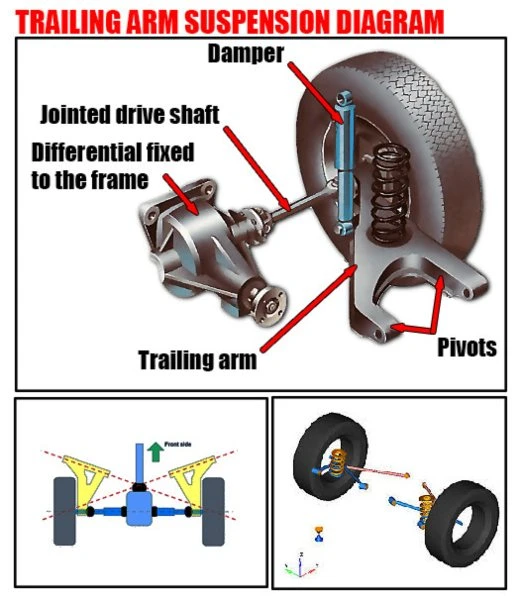
Long arm is fitted on the car body at its front end and at the rear at the wheel hub. The arm extends and blows like a hinge and follows behind its point of mounting.
Key Components
- Trailing Arm: The principal longitudinal steel member.
- Spring: It is typically a coil spring that is mounted in the arm.
- Shock Absorber: Single display that is mounted in an upright position to regulate motion.
Avantages
- Simple Design: The design has very few moving parts.
- Comfortable Ride: This is good at absorbing forward-facing impacts.
Les inconvénients
- Limited Performance: Not very good at high speed concerning tipping the wheel over.
Idéal pour
- Compact cars.
- The back axle of front-wheel drives.
Additional Info
It occupies less space and this is useful in small cars where space is a constraint in designs.
Driving Feel
Perfect in the city and not good for aggressive driving.
Air Suspension
How It Works
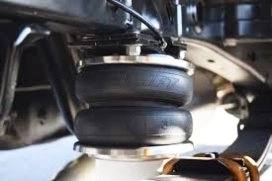
It uses rubber bags with compressed air instead of the conventional metal springs. The computer identifies the road and adapts the air pressure within milliseconds to alter the feel of the car.
Key Components
- Air Compressor: Forces air into the system.
- Airbags: This is the springing that supports the car.
- Sensors: Measuring the heights and road condition.
Avantages
- Maximum Comfort: Floats like pillaging on the cloud.
- Adjustable Road Height: Has the ability to lower the car when needed speedily or to elevate the car when required off-road.
Les inconvénients
- Costly: To purchase and deliver as well as repair.
- Complex System: There is a risk of air leakage or malfunctioning of the electronics.
Idéal pour
- Luxury cars.
- Luxury SUVs and tow trucks.
Additional Info
This system will be able to regulate itself automatically depending on the conditions on the road or the driving mood.
Driving Feel
There is a very smooth and floating ride, which is particularly experienced on the highways.
Conseils d'entretien
Air suspension requires frequent inspections since leaks may decrease the performance.
Dependent Suspension Systems Explained
What is Dependent Suspension Sysyem?
There is a single beam in this type of system, which connects both wheels at an axle. When the left wheel collides with something, which causes it to rise, then the right wheel must tilt or move too.
This makes it:
- Strong: Able to support huge weight.
- Simple: Lower degrees of failure.
- Good for Heavy Loads: The wheels are kept parallel to each other when under pressure.
Extra Insight
This type is tougher and performs better in extreme conditions such as off-road and construction sites.
Solid Axle Suspension
How It Works
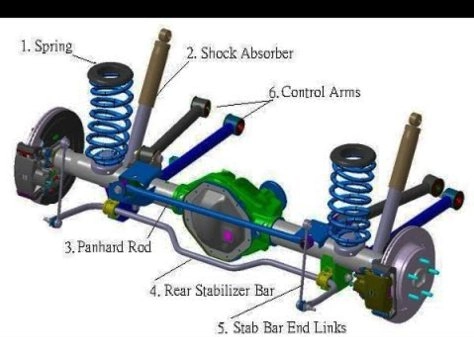
Two wheels are attached together with a strong rigid beam. Within this beam (on driven wheels), the drive shafts pass the power to the tires.
Key Components
- Essieu: A steel housing of heavy weight.
- Springs: They can either be leaf springs or coil springs.
Avantages
- Very Strong: Incapable of being subjected to extreme abuse and heavy towing.
- Durable: The number of moving parts that break during off-roading is reduced.
Les inconvénients
- Less Comfort: All the bumps on one side can be perceived on the other.
- Poor Handling: The car is clunky due to the heavy axle (unsprung weight).
Idéal pour
- Trucks
- Off-road cars (such as the Jeep Wrangler).
Additional Info
This system is able to support extreme loads without being damaged. This is the reasoning it is used by heavy vehicles.
Driving Feel
You can experience additional bumps, particularly on the rough roads.
Torsion Beam Suspension
How It Works
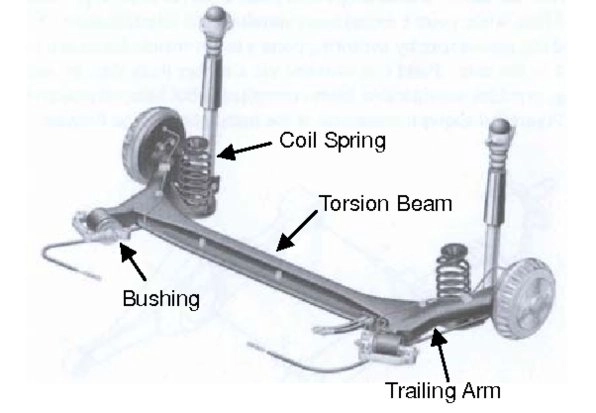
A larger beam that connects the wheels on the rear of small cars is often used but it is constructed in such a way that it twists a little when loaded such that it functions as a semi-independent system.
Key Components
- Torsion Beam: This is an H-shaped or U-shaped beam of metal.
- Springs: Coil springs are usually used.
Avantages
- Low Cost: It is very cheap to manufacture.
- Small Size: Saves on space to have a larger trunk or a fuel tank.
Les inconvénients
- Less Comfortable than Independent systems: Still feels some vibration on the cross arm.
Idéal pour
- Budget cars.
- Compact hatchbacks.
Expert Insight
It is a semi-independent system since it has a small degree of flexibility.
Driving Feel
The best of solid Axle and not as smooth as independent suspension.
Leaf Spring Suspension
Comment ça marche :
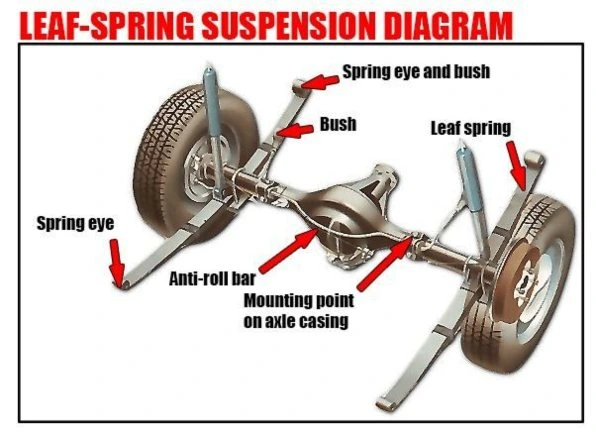
It involves a number of layers of flexible steel strips (leaves) that are piled one on top of the other. The resistance among the strips contributes to the dampening of the ride and the heavy loads.
Key Components
- Leaf Springs: The pile of curved plates made of metal.
- Essieu: Usually a solid axle.
Avantages
- Handles Heavy Loads: Balances the weight on the chassis of the vehicle.
- Strong and Durable: Hardly breakable.
Les inconvénients
- Heavy: The points mean a significant weight to the car.
- Less Comfortable: This is usually rough when the car is not in use.
Idéal pour
- Commercial Trucks.
- Pickup vehicles.
Additional Info
It is among the oldest suspension systems, yet it is still favored because of its strength.
Driving Feel
You get a feeling of stiffness, particularly when the vehicle is not in use.
De Dion Suspension
How It Works
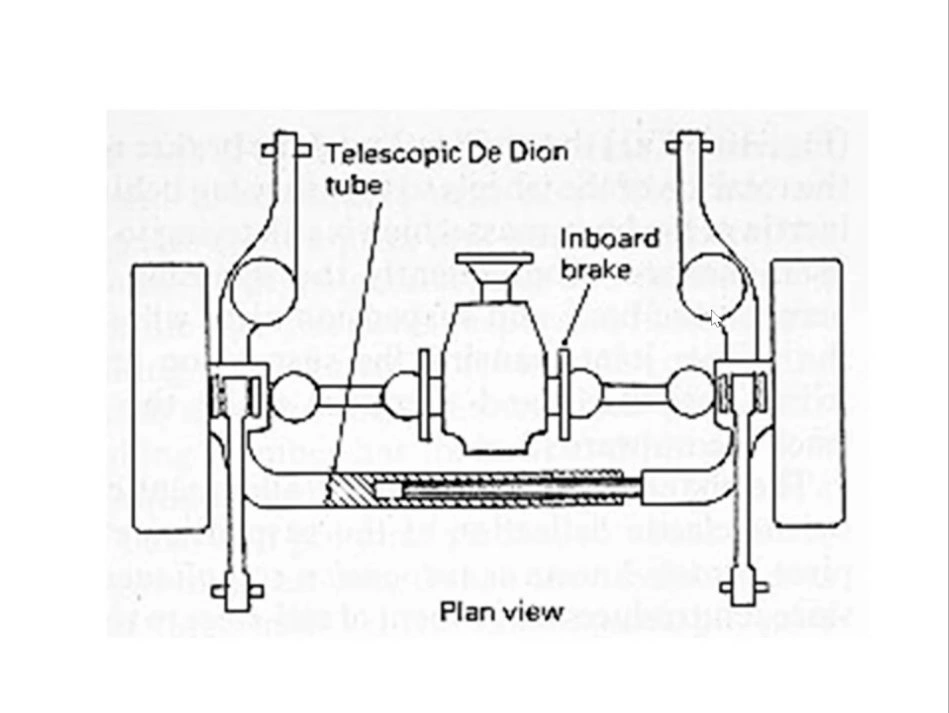
It is a high-technology hybrid. It incorporates a solid tube to hold wheels together (dependent) yet the heavy differential (gears) is fastened to the car frame (independent). This makes the weight carried by the wheels less.
Key Components
- De Dion Tube: This is a hollow between the hubs.
- Driveshaft: It has universal joints that will be able to move.
Avantages
- Better Stability Than a Solid Axle: The wheel remains vertical due to the lack of the weight of the differential.
- Less Weight on Wheels: Enhances road traction on rough roads.
Les inconvénients
- More Complex: It consists of more costly joints and tubes.
Idéal pour
- There are performance cars (such as older Alfas and Caterhams).
- Specialized sports car.
Additional Info
The system lowers the unsprung weight and this enhances a better ride over a solid axle.
Driving Feel
You have a compromise of comfort and strength.
Which Car Suspension System is Best For You
It depends on your needs:
- Conduite quotidienne : MacPherson or Torsion Beam.
- Luxury and Comfort: Air suspension or multi-link.
- Performance Driving: Double wishbone.
- Heavy Loads: Solid axle or leaf spring.
Select according to the way and place of driving.
Common Signs Your Car Suspension Needs Repair
Watch for these signs:
- Rough or bumpy ride.
- Car pulles on one side.
- Uneven tire wear.
- Car keeps bouncing.
When you check on these, have your suspension checked.
Tips to Maintain Your Car Suspension System
- Be cautious when using bad roads.
- Suspend checks on a regular basis.
- Check tires and ensure that they are inflated.
- Replace worn-out shocks.
Suspension can be retained longer by good maintenance.
Final Thoughts: Choose HDC Manufacturer for Car Suspension System
It is important to find the proper suspension system based on the road conditions, budget and driving styles. Other systems have their priorities on comfort, whereas some are on strength or performance. It is always advisable to have an appropriate system that suits your day-to-day activities to be able to have a more enjoyable and hassle-free driving experience.
À HDC Manufacturer, our products are high-quality, custom-made suspension parts to enhance comfort, safety and performance. Our specialization is in forging, casting, and CNC machining, and this enables us to provide strong, durable, and precision-made parts to various types of vehicles. We provide you with durable control arm solutions or other automotive parts that are needed by you. In case you are seeking a partner you can rely on, we will be happy to assist you.
Find the correct suspension parts in our solutions and call us today to determine what you need to build your project.
Please learn more about our services here:
https://hdcmfg.com/capabilities/aluminum-forging-service/
FAQ
Which type of car suspension is best?
There is no single best type. Multi-link and air suspension are most comfortable and the solid axle should be heavy duty.
Is independent suspension better than dependent?
Yes, independent suspension is more comfortable and handles better. Dependent suspension is more powerful and suitable for heavy loads.
What suspension is used in most cars?
MacPherson suspension is common in most modern cars due to its simplicity, cheapness and efficiency.
Which suspension is best for bad roads?
Long travel and a solid axle suspension system are ideal on rough, uneven roads.
How long does a car suspension last?
The suspension parts can last between 50,000 and 1,000,000 km, depending on the conditions of use and maintenance.