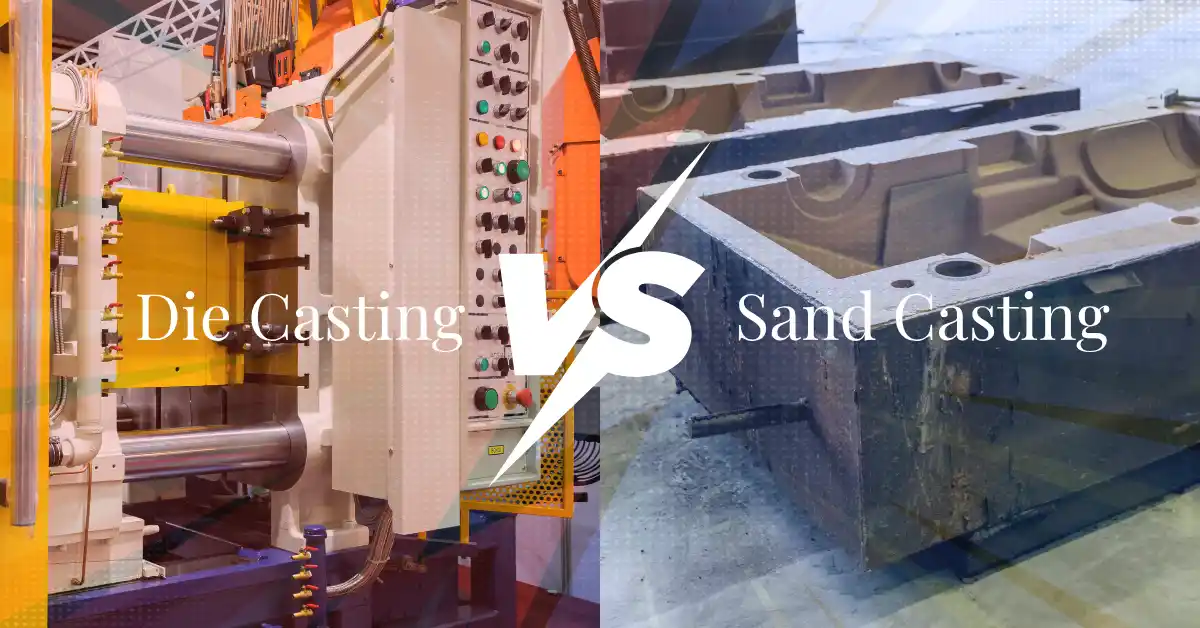
If you are comparing مقارنة بين LPDC و HPDC و GDC, you are really deciding how the metal should fill the mold, how much integrity the casting needs, and how much you are willing to invest in tooling to get the right part cost at volume. These three processes all use metal dies, but they behave very differently in terms of fill speed, pressure, porosity risk, wall thickness capability, and post-machining needs. For buyers, the right choice usually comes down to one question: do you need the fastest route, the cleanest internal structure, or the most economical permanent-mold process for a medium-volume metal part?
What Each Process Actually Means
GDC, or gravity die casting, is the simplest of the three. Molten metal is poured into a reusable metal mold and fills the cavity mainly under gravity. In many industries, this is also called permanent mold casting. It is typically used where buyers want better repeatability and surface quality than sand casting, but do not need the speed or complexity of high-pressure injection. The Aluminum Association’s standards for aluminum sand and permanent mold castings and HDC’s own aluminum casting service both place permanent mold casting in exactly that practical middle ground.
LPDC, or low-pressure die casting, still uses a metal mold, but the metal is pushed upward from below the melt surface into the die by controlled low gas pressure. European Aluminium’s casting-methods guide describes this as smooth bottom-up filling with clean melt, and notes that the process is especially well known for aluminum wheels, cylinder heads, and similar structural castings. Because the mold fills from the bottom and remains connected to the melt during solidification, the process supports better feeding than gravity filling alone.
HPDC, or high-pressure die casting, is the fastest and most production-oriented route. Molten metal is injected into the die cavity at high speed under high pressure. NADCA’s product standards describe HPDC as a process capable of near-net-shape components, precision tolerances, good cosmetic surface quality, and strong productivity at volume. This is why HPDC dominates large-volume aluminum and zinc parts in automotive, electronics, housings, and many consumer-facing industrial products.
The Real Comparison Starts with How the Mold Is Filled
The most important technical difference between LPDC, HPDC, and GDC is the way the mold fills, because fill behavior drives porosity, turbulence, productivity, and the kind of geometry each process handles best.
في GDC, filling is gravity driven. That makes the process mechanically simpler, but it also means the foundry has less active control over how the metal front moves compared with pressure-assisted systems. GDC can produce good-quality aluminum castings, especially when the mold and gating are well designed, but it is more sensitive to section changes and feeding than LPDC. The same European Aluminium source that describes LPDC also uses gravity die cast wheels as a comparison case and shows that gravity die cast wheels require larger risers than their LPDC counterparts because feeding is less actively supported.
في LPDC, the metal rises smoothly into the cavity from below. That one change improves several things at once. The fill is calmer, oxide disturbance is reduced, and the casting remains connected to the melt during solidification so pressure can continue to feed the last-freezing regions. European Aluminium notes that LPDC offers smooth bottom-up filling with clean melt and that increasing pressure helps guarantee feeding. A technical LPDC paper also describes low-pressure filling as a process that combines smooth mold filling, compact structure, high process yield, and suitability for thin-walled or structurally demanding castings.
في HPDC, the die is filled very quickly and under much higher pressure. This gives the process its commercial strength: speed, repeatability, and thin-wall capability. But it also creates its main limitation. If the die, gating, venting, or vacuum strategy are not right, air entrapment and gas-related integrity problems become much more likely than in slower, calmer filling routes. NADCA treats this directly by separating conventional HPDC from high-integrity and structural die casting, where vacuum and tighter process control are needed when the part must be weldable, heat treatable, or more structurally reliable.
What This Means for Porosity and Internal Quality
For buyers, internal quality is often the real decision driver. If the part must hold pressure, be heat treated after casting, or machine cleanly in structural zones, LPDC and GDC are not automatically interchangeable with HPDC.
LPDC often has an advantage when internal soundness matters because the metal enters more quietly and the pressure-assisted feed during solidification helps reduce shrinkage-related problems. This is one reason LPDC is so strongly associated with aluminum wheels and some structural automotive castings. European Aluminium explicitly links LPDC with wheel production and shows its feeding advantage over gravity die cast wheels.
GDC can also produce structurally sound parts, but the process depends more heavily on traditional feeding design and thermal control. It is often a good fit when the part is not extremely thin-wall, the volume is moderate, and the buyer wants a reusable metal mold route without the complexity and cost of HPDC tooling. Permanent mold casting guidance from industry sources consistently positions it as a route with better grain structure and consistency than expendable-mold processes, but without the same throughput as HPDC.
HPDC usually wins on productivity, but buyers should be cautious if they assume it automatically provides the best internal quality. It can, in the right high-integrity or vacuum-assisted setup, but conventional HPDC is more sensitive to entrapped gas because of the fast fill and pressure profile. That is why high-integrity HPDC exists as a defined process category rather than just a marketing label.
Part Geometry, Wall Thickness, and Typical Applications
This is where the decision usually becomes easier.
If the part has thin walls, high production volume, strong cosmetic requirements, and many near-net details, HPDC is usually the leading candidate. NADCA’s design and specification guidance emphasizes that die casting can often reduce or eliminate machining because of the ability to cast dimensions, holes, and features to precision tolerances at high volume.
If the part is structural aluminum, needs better integrity, or benefits from calmer bottom-up filling, LPDC becomes much more attractive. This is why LPDC is so common in wheels, some cylinder heads, and other parts where the casting must do more than just look good. European Aluminium’s process guide highlights LPDC especially for wheels, V-engine blocks, and air-cooled cylinder heads, which reflects where the process tends to make economic and technical sense.
If the part is medium volume, more robust in wall section, and does not justify HPDC die investment or cycle-speed expectations, GDC often becomes the practical answer. It is especially relevant when the buyer wants a permanent-mold process with good repeatability and decent surface quality, but without the full complexity of high-pressure die-casting systems. HDC’s aluminum casting service also reflects this logic by positioning permanent mold casting as a route that combines consistent quality with cost efficiency.
| عامل | LPDC | HPDC | GDC |
| Mold filling | Low-pressure, bottom-up | High-speed, high-pressure injection | Gravity-fed into metal mold |
| Typical strength of process | Better filling calmness and feeding | Highest productivity and thin-wall capability | Simpler permanent-mold route with good repeatability |
| Internal integrity | Often strong for structural aluminum parts | Depends heavily on venting, vacuum, and process control | Good, but more dependent on feeding design than LPDC |
| Tooling / capital | Higher than GDC, lower than many full HPDC cells depending on program | Highest tooling and equipment commitment | Lower than HPDC; moderate permanent-mold investment |
| Best-fit volume | متوسطة إلى عالية | High to very high | Low to medium, sometimes medium-high |
| Typical applications | Wheels, cylinder heads, structural aluminum castings | Automotive housings, thin-wall parts, complex near-net production | Brackets, housings, medium-volume aluminum parts |
The table is intentionally practical rather than academic. It is meant to help a buyer choose the process family before fine-tuning alloy and geometry details.
Cost, Tooling, and Machining Reality
The cheapest-looking process on paper is not always the cheapest finished part.
HPDC has the strongest case when volume is high enough to repay the die and machine investment. Once that scale exists, the process can be hard to beat because of cycle time, dimensional repeatability, and the ability to reduce machining on many features. NADCA’s specifications make this point directly: die casting is often used to capitalize on improved dimensional accuracy, stability, and reduction in part-machining costs.
LPDC usually sits between GDC and HPDC commercially. Its productivity is limited by longer cycle times because the casting remains connected to the melt during solidification, but the tradeoff is better feeding and often better integrity. European Aluminium notes that LPDC cycle times are longer for exactly this reason. Buyers should read that not as a weakness but as part of the process logic: LPDC is trading speed for quality in the casting itself.
GDC often becomes attractive when the buyer wants a reusable-die process but not the full automation and tooling economics of HPDC. It can be a very good commercial answer for medium-volume parts that need decent quality but do not justify high-pressure tooling. It also tends to be easier to discuss as a step up from sand casting and a step down from HPDC in terms of both cost and complexity.
Across all three processes, the most expensive mistake is often expecting the as-cast part to do too much. If the part has bearing seats, sealing faces, datums, or tightly located bolt patterns, buyers should assume that selective CNC finishing may still be the smartest route, even when the process is dimensionally strong overall.
How a Buyer Should Make the Decision
A practical buyer should start with three questions.
First, does the part need speed and thin-wall productivity, or does it need higher integrity? If speed and near-net volume are the priority, HPDC usually leads. If integrity and calmer filling matter more, LPDC or GDC become stronger candidates.
Second, what is the real annual volume? HPDC gets stronger as volume rises. GDC is often more commercially comfortable at lower or medium volumes. LPDC makes sense when the structural benefit and feeding control justify its longer cycles.
Third, which features must be trusted after machining? If the part will be machined heavily in structural or sealing zones, internal quality matters more than raw piece speed. That is where LPDC often earns its place, and where GDC may still work if the design is favorable. HPDC can also work well, but only if the program is truly engineered for integrity rather than simply for output.
Where HDC Fits
If the part belongs in the aluminum casting family but the best process is not yet obvious, HDC fits most naturally as a process-selection partner rather than just a quote source. Through its broader metal casting capability and dedicated die-casting capability, HDC supports buyers who need help balancing integrity, geometry, volume, and post-machining requirements. Its casting services are structured around the same decision logic buyers should be using: choose the right process first, then finish the critical interfaces properly.
الأسئلة الشائعة
Is LPDC just a slower version of HPDC?
No. LPDC is not simply HPDC with less pressure. It is a different filling logic, usually bottom-up and calmer, with pressure also supporting feeding during solidification. That is why LPDC is often chosen for wheels and structural castings rather than for the same parts typically made in conventional HPDC.
Is GDC the same as permanent mold casting?
In most industrial discussions, yes. Gravity die casting usually refers to permanent-mold casting where the metal enters the die mainly by gravity rather than by high-pressure injection.
Can HPDC parts be structural?
Yes, but that usually means high-integrity or structural die-casting practice, often with vacuum and tighter process control, not just a standard conventional HPDC route.
Which process usually needs the least machining?
HPDC often performs best on near-net detail at high volume, but the answer depends on the feature. Structural or sealing-critical areas in any of the three processes may still need machining if the buyer wants the finished part to be consistently reliable.
خاتمة
LPDC, HPDC, and GDC are all die-based casting processes, but they solve different buyer problems. HPDC is usually the strongest answer when output, thin walls, and near-net repeatability matter most. LPDC becomes attractive when the part needs smoother filling, better feeding, and stronger internal integrity, especially in structural aluminum applications. GDC is often the practical middle route when a reusable metal mold makes sense but the part does not justify HPDC-level investment or complexity. The right decision comes from matching fill behavior and part function, not just comparing process names.