Cuando vemos un edificio, un coche o una máquina modernos, no solemos pensar en el proceso de fabricación del metal que hay dentro. La colada continua es un proceso eficiente que se utiliza en casi todas las estructuras de acero.
Esto ha transformado la forma en que las industrias fabrican metales. En lugar de producirlos por lotes, las fábricas los producen de forma continua y sin interrupciones. Esto implica mayor velocidad y calidad de producción, además de una reducción del desperdicio.
Esta guía le ayudará a comprender cómo funciona realmente el flujo continuo, por qué es el preferido por las industrias y en qué áreas se está utilizando.
¿Qué es la fundición continua?
La colada continua es un proceso de fabricación en el que el metal caliente (metal líquido) se transforma en forma sólida sin interrupción.
Este proceso no requiere verter el metal repetidamente en moldes separados, sino que permite que el metal fluya continuamente. Se solidifica durante el movimiento, formando figuras alargadas como planchas, lingotes o formas florales.
¿Cómo funciona el proceso de colada continua?
Y ahora lo dividiremos paso a paso para que lo comprendas fácilmente.
Paso a paso Audiciones continuas Proceso
Fundir el metal
En primer lugar, las materias primas, como el mineral de hierro o la chatarra, se funden en un horno. Esto da lugar a metal fundido a altas temperaturas.
Vertiendo en el Tundish
El metal fundido fluye hacia una artesa. Esto regula el flujo y proporciona un flujo uniforme sobre el molde.
Fluir dentro del molde
El metal líquido se bombea desde la artesa a un molde refrigerado por agua. Esta es la forma básica del metal que proporciona este molde.
Comienza la solidificación
Cuando el metal entra en contacto con el molde frío, su parte exterior comienza a solidificarse. Por dentro es líquido.
Retiro continuo
El metal es arrastrado hacia abajo (o lateralmente) por rodillos. Cuanto más avanza, más se solidifica.
Zona de refrigeración
El metal se rocía con agua, lo que lo enfría aún más hasta que se solidifica por completo.
Corte
Por último, las máquinas cortan los largos hilos de metal a la longitud deseada.
Todo el proceso no se detiene, sino que avanza de forma continua y, por lo tanto, es altamente eficiente.
Proceso de colada continua
Supongamos que vas a hacer una barra de chocolate larga:
- Se vierte el chocolate líquido en un molde.
- A medida que avanza, se enfría.
- Lo cortas en trozos.
Así es como se realiza la colada continua, pero solo con metal.
Componentes principales de una máquina de colada continua
Para comprender mejor el proceso, es necesario familiarizarse con los componentes clave de la máquina.
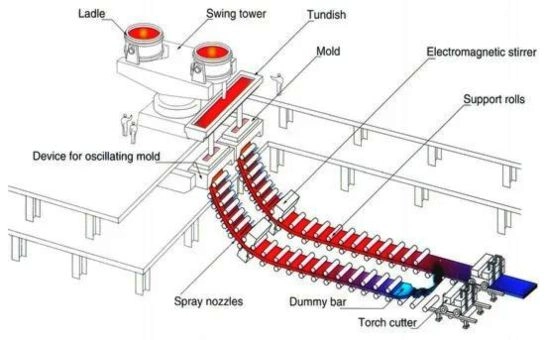
Tundish
- Contiene metal fundido.
- Los controles fluyen en el molde.
- Ayuda a eliminar las impurezas.
Moho
- Refrigerado por cobre y agua.
- Da forma al metal.
- Inicia el proceso de endurecimiento.
Sistema de refrigeración
- Utiliza rociadores de agua.
- Endurece el metal por completo.
Rodillos
- Separe el metal tirando.
- Ayudar en el enfriamiento.
Máquina de corte
- Dobla el metal a las medidas necesarias.
Todos sus componentes son fundamentales para garantizar la calidad y la velocidad.
Tipos de continuo Fundición
Fundición continua No es un proceso cualquiera. Difieren en cuanto a su forma y diseño de la máquina.
Tipos según la forma
Fundición de palanquillas
La fundición a partir de lingotes permite crear piezas metálicas pequeñas, cuadradas o redondas. La sección transversal de estos lingotes suele ser menor que la de otros tipos.
Los lingotes se utilizan frecuentemente para fabricar:
- Barras de acero
- Varillas
- alambres
- Barras de refuerzo (varillas de acero)
Debido a su facilidad de manipulación y procesamiento, las industrias utilizan lingotes en sus líneas de productos que requieren conformado, laminado o trefilado. Este tipo de material es muy popular en la construcción y la industria manufacturera.
Fundición de Bloom
Las piezas fundidas a partir de lingotes son de mayor tamaño que las piezas fundidas a partir de palanquillas, y suelen ser rectangulares o cuadradas.
Estas flores se utilizan para hacer:
- Vías férreas
- Vigas estructurales
- Componentes metálicos de alta resistencia
Las láminas Bloom son adecuadas para obras de construcción pesada e infraestructura, ya que son más gruesas y resistentes. Son más resistentes y duraderas en aplicaciones a gran escala.
Fundición de losas
La colada en planchas se utiliza para dar forma a piezas metálicas anchas y planas. Estas planchas tienen un gran ancho y un espesor relativamente pequeño.
Principalmente, se utilizan para fabricar:
- Láminas de metal
- Placas de acero
- Bobinas para automóviles y electrodomésticos.
Las planchas son muy demandadas en las industrias que requieren productos metálicos planos, como la fabricación de automóviles, la construcción naval y la producción de electrodomésticos.
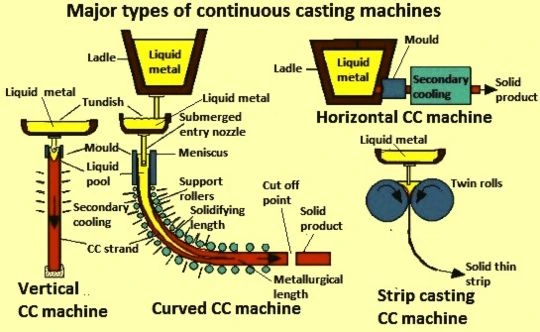
Tipos basados en el diseño de la máquina
Fundición vertical
En la fundición vertical, el metal fundido se dirige directamente hacia abajo del molde. El metal se desplaza a través de la máquina con la ayuda de la gravedad.
Puntos clave:
- Diseño sencillo y simple.
- Necesita un edificio alto o una torre.
- Tiene un buen control de la solidificación.
Actualmente no se utiliza tanto, ya que ocupa más espacio vertical, aunque todavía tiene algunas aplicaciones especializadas.
Fundición curva
El diseño más común en las industrias modernas es la fundición curva. En este proceso, el metal se tira inicialmente hacia abajo, pero luego describe una trayectoria curva y, posteriormente, se vuelve horizontal.
Ventajas clave:
- Ahorra espacio en comparación con la fundición vertical.
- Permite una regulación más eficaz del enfriamiento y la solidificación.
- Permite la producción a alta velocidad.
Debido a su eficiencia y pequeño tamaño, la mayoría de las máquinas de colada continua actuales adoptan esta técnica.
Fundición horizontal
La fundición horizontal es aquella en la que el metal fundido fluye horizontalmente en lugar de verticalmente.
Está diseñado para aplicarse a:
- Ciertos metales y aleaciones.
- Montajes de producción más pequeños.
- Aplicaciones especializadas.
Aunque menos extendida que la fundición curva, resulta eficaz cuando hay escasez de espacio vertical o al crear ciertos tipos de productos.
Aplicaciones de Audiciones continuas
La colada continua se ha utilizado en la mayoría de las industrias debido a su eficiencia y calidad.
| Industria | Ejemplo de aplicación |
| Industria siderúrgica | Producción de acero en masa |
| Industria automotriz | Piezas de motor, chasis de automóviles |
| Construcción | Edificios, puentes |
| Industria de tuberías y tubos | Tuberías de petróleo, gas y agua |
| Maquinaria pesada | Equipos industriales |
Principales ventajas de la colada continua
Ahora examinaremos las razones por las que las industrias prefieren la colada continua.
Alta eficiencia de producción
Es un proceso continuo, lo que permite ahorrar tiempo y aumentar la producción.
Reducción de residuos de materiales
Se desperdicia menos metal en comparación con los métodos tradicionales.
Mejor calidad del producto
La colada continua da como resultado un metal uniforme y consistente con menos defectos.
Ahorro de energía
Ahorra energía al eliminar la necesidad de recalentar.
Menor costo de producción
Menos pasos se traducen en menos costes y mayores beneficios.
Compatible con la automatización
En los sistemas modernos se emplean sensores y automatización para mejorar el control. En general, el proceso mejora tanto la productividad como la calidad.
Fundición continua frente a fundición a la cera perdida
Mucha gente confunde la colada continua con la colada de precisión. Pero son muy diferentes.
| Característica | Audiciones continuas | Fundición a la cera perdida |
| Tipo de proceso | Continuo | Lote |
| Producción | Secciones metálicas largas | Formas complejas |
| Velocidad de producción | Alto | Más lento |
| Costo | Reducido a gran escala | Más alto |
| Precisión | Moderado | Muy alto |
¿Cuándo utilizar la fundición continua?
- Producción a gran escala.
- Formas simples.
- Se requiere alta eficiencia.
¿Cuándo utilizar la fundición a la cera perdida?
- Diseños complejos
- Piezas de alta precisión
- Pequeñas series de producción
Desafíos y limitaciones de la colada continua
Si bien la colada continua es un proceso potente, tiene ciertas limitaciones.
Alto costo de instalación
Las máquinas y su instalación son costosas.
Equipos complejos
Se necesitan operarios y personal de mantenimiento con experiencia.
Flexibilidad limitada
La producción a pequeña escala y personalizada no es opcional.
Necesidades de mantenimiento
Las máquinas no deberían tener problemas para funcionar.
Últimas tendencias en tecnología de colada continua
La colada continua se está viendo mejorada por la tecnología.
- Automatización e IA: Los sistemas inteligentes controlan la temperatura, la velocidad y la calidad.
- Técnicas avanzadas de refrigeración: Una mejor refrigeración mejora la calidad del producto.
- Monitoreo en tiempo real: Los problemas se detectan en una fase temprana y se evitan los defectos.
- Mejoras ecológicas: Los nuevos sistemas minimizan el consumo de energía y las emisiones.
Estos inventos ayudan a las industrias a fabricar metal de calidad con un mínimo de residuos.
Conclusión
La colada continua es uno de los procesos que ha cobrado mayor importancia en la fabricación contemporánea. Permite a las industrias producir metal a menor costo, con mayor rapidez y con una calidad superior. Este proceso es fundamental en los productos que consumimos a diario, ya sean procedentes de acerías o de proyectos de construcción.
En Fabricación de HDC, Sabemos cómo las distintas técnicas de fundición afectarán la calidad y el coste de los productos. La fundición continua se puede utilizar en la producción a gran escala, pero en nuestro caso nos interesa proporcionar soluciones de alta precisión basadas en fundición a la cera perdida.
Si busca opciones de casting confiables para su proyecto, podemos asesorarle sobre el enfoque adecuado para obtener los mejores resultados. Contáctenos hoy mismo, cuéntenos sus necesidades y reciba asistencia profesional.
preguntas frecuentes
¿Para qué se utiliza la colada continua?
Produce productos metálicos como planchas, lingotes y palanquillas que se utilizan en las industrias de la construcción, la automoción y la fabricación.
¿Cuáles son las ventajas de la colada continua?
Es muy eficiente, de alta calidad, genera menos residuos y su producción es económica.
¿En qué se diferencia la colada continua de la colada tradicional?
En la fundición tradicional, cada pieza se funde en un molde separado, mientras que en la fundición continua, el metal se funde en un flujo continuo.
¿Es rentable la colada continua?
Sí, sobre todo en la producción a gran escala, ya que minimiza los residuos y el consumo de energía.
¿Qué metales se pueden utilizar en la colada continua?
La colada continua se puede utilizar con acero, aluminio, cobre y numerosas aleaciones.