You can get everything else right and still end up with a part that fails.
The right alloy. The right geometry. The right tolerances. But if you overlook surface finish, you inherit problems that show up later, at the worst possible stage of production or, worse, in the field.
Surface finish affects how your casting performs under load, how well it resists corrosion, how effectively coatings bond to it, and how much machining is required to bring the part to final specification.
In casting manufacturing, small surface defects rarely stay small for long.
What Is Casting Surface Finish?
Casting surface finish refers to the texture, smoothness, and overall condition of a casting after it leaves the mold. It describes how refined or rough the outer surface appears before secondary operations such as machining, polishing, or coating begin.
Some casting processes naturally produce cleaner, smoother surfaces, while others leave behind rougher textures that require additional finishing. The final surface condition affects everything that happens after casting, from machining and coating to inspection and assembly.
How Surface Finish Is Measured
Surface finish is commonly measured using surface roughness values such as Ra, which represents the average roughness across a surface. Lower Ra values indicate smoother finishes, while higher values indicate rougher textures.
For example, a polished consumer electronics housing requires a much lower Ra value than a large industrial pump casing, where appearance matters less.
Engineers use instruments called profilometers to measure these microscopic surface variations. These devices drag a stylus across the surface, recording peaks and valleys that are often invisible to the naked eye.
Surface finish measurements help determine whether a casting is suitable for applications involving:
- Coating and painting
- Usinage
- Sealing surfaces
- Résistance à la corrosion
- Decorative appearance
- Wear resistance
The acceptable roughness level depends entirely on how the part will be used.
Why Surface Finish Matters in Casting Manufacturing
Surface finish affects far more than appearance. A poor surface can create weak points where cracks begin under stress. In pressure-containing components, rough surfaces may create leakage paths. During coating or painting, uneven textures reduce adhesion and shorten product lifespan.
Machining costs also vary significantly with surface quality. A rough casting behaves like a road filled with potholes. Cutting tools experience more resistance, material removal becomes less consistent, and production slows down as tool wear increases.
In industries such as aerospace and medical manufacturing, surface quality directly affects safety and reliability. A tiny surface defect on a turbine blade or implant can eventually lead to a major failure in service.
Because surface finish is closely tied to part performance, manufacturers pay careful attention to the conditions that shape the casting surface from the very beginning of production.
Factors That Affect Casting Surface Finish
A casting surface does not turn rough or smooth by accident. Every mark, texture, and irregularity on the final part usually reflects what happened during production.
Several production conditions directly shape how smooth, rough, or defect-free the final casting surface becomes:
Mold Material and Mold Quality
The mold surface plays the biggest role in determining casting finish quality. Fine mold materials create smoother surfaces, while coarse materials create rougher textures.
In sand casting, grain size strongly affects surface appearance. Fine-grain sand creates cleaner finishes because the gaps between particles are smaller. Poorly compacted molds can also break apart during pouring, leaving surface defects behind.
Permanent steel molds used in die casting produce much smoother finishes because the cavity walls are rigid and highly polished.
Metal Type and Alloy Composition
Different metals flow and solidify differently inside a mold. Aluminum and zinc flow easily and reproduce surface detail very well. Cast iron behaves differently because of its graphite structure and solidification characteristics.
Some alloys shrink more aggressively during cooling, which increases the risk of cracks, porosity, and surface distortion. High-temperature alloys can also react with mold materials, creating oxidation or burn-in defects on the surface.
The behavior of molten metal inside the mold is similar to pouring different liquids across a floor. Water spreads smoothly, while thick syrup moves slowly and unevenly. Metal alloys behave in much the same way during casting, and that behavior directly affects how smooth, rough, or defect-free the final casting surface becomes.
Pouring Temperature and Cooling Rate
Pouring temperature directly affects mold filling and surface quality. If the temperature is too low, the metal may solidify before the cavity fills, creating cold shuts or misruns.
Excessively high temperatures can create turbulence, oxidation, and mold erosion. The cooling rate also affects the final surface texture. Uneven cooling creates thermal stress that may cause surface cracks or distortion.
Controlled solidification helps maintain both dimensional stability and surface consistency across the casting.
Gating and Risering Design
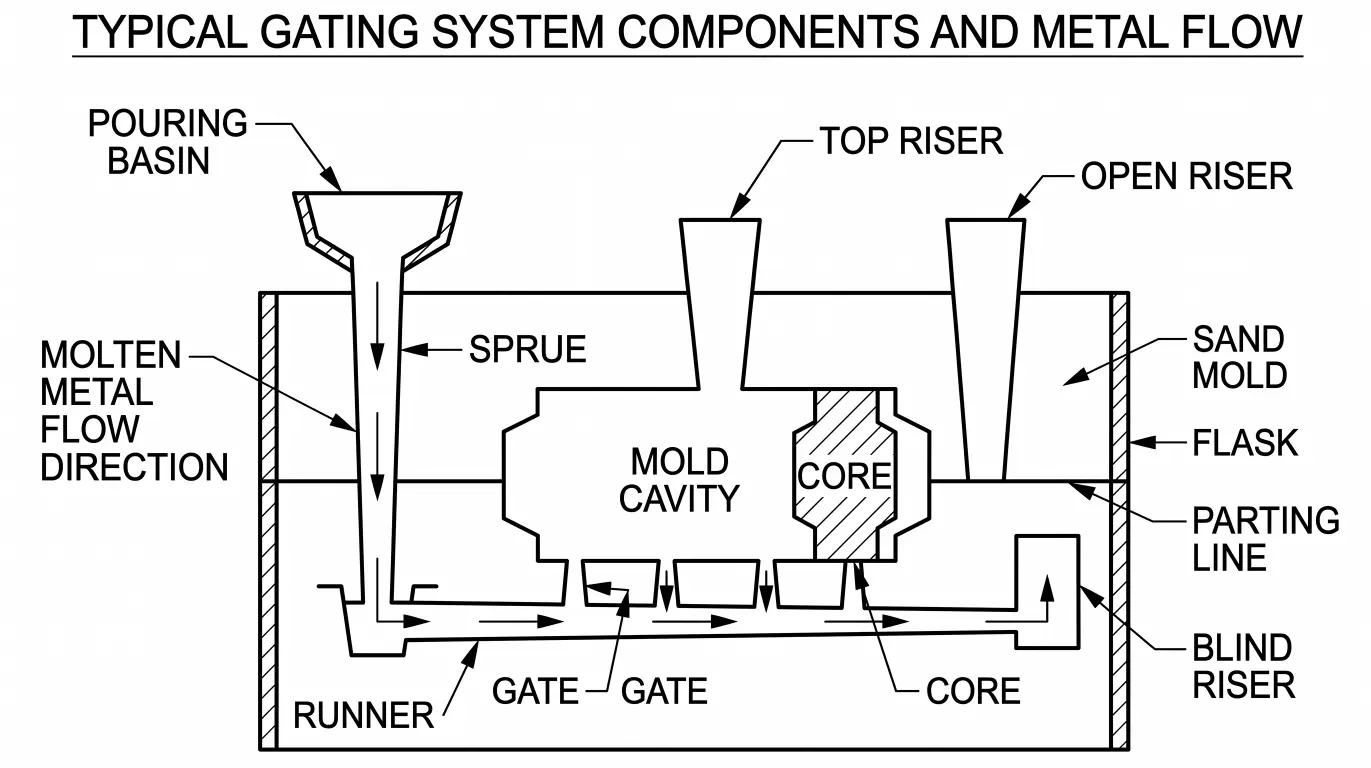
The gating system controls how molten metal enters the mold cavity. Poor gating design creates turbulence, trapped air, and inconsistent metal flow.
Risers help feed molten metal during solidification. Without proper risering, shrinkage defects may form near the surface or inside the casting.
A poorly designed gating system behaves like traffic entering a narrow highway during rush hour. Turbulence builds quickly, the flow becomes unstable, and defects begin to appear throughout the process.
Pattern and Tooling Quality
Pattern accuracy directly affects casting quality. Worn or damaged tooling transfers imperfections into every part produced.
High-quality tooling creates cleaner mold cavities, better dimensional consistency, and smoother surfaces. In high-volume production, even small tooling defects can multiply into thousands of defective castings over time.
What Are the Most Common Casting Surface Defects?
The following are some of the most common surface defects in metal castings:
- Metal Penetration: This occurs when molten metal flows between sand particles during pouring. It creates a rough, irregular surface that resembles hardened metal fused with sand. High pouring temperatures and weak mold strength usually cause this defect.
- Sand Inclusion and Burn-In: Sand inclusion happens when loose sand particles break away from the mold and become trapped inside the metal surface. Burn-in occurs when molten metal partially fuses with the mold material. Both defects create rough surfaces and increase machining requirements.
- Cold Shuts and Misruns: Cold shuts form when two streams of molten metal fail to fuse properly inside the mold cavity. Misruns occur when the mold does not fill before solidification. These defects usually result from poor temperature control or improper gating design.
- Porosity and Blowholes: Porosity consists of tiny voids trapped inside or near the surface of a casting. Blowholes are larger gas pockets caused by trapped air or moisture. These defects weaken the part and may create leakage problems in pressure-sensitive applications.
- Surface Cracks and Hot Tears: Surface cracks and hot tears develop when thermal stresses build up during solidification. Uneven cooling or restricted shrinkage often causes these problems. These defects are especially dangerous because they can spread during service under repeated loading or vibration.
These defects may appear differently on the surface, but they all point to one thing: a loss of process control at some point during casting production. However, many of them can be reduced or prevented when the right production practices are in place.
How Surface Finish Affects Your Machining and Production Cost
Your casting surface finish directly affects the time, labor, and money required for the rest of the production process. Rough castings usually require additional grinding, polishing, and machining before they reach final specification. That extra work increases machining time, accelerates tool wear, and raises overall production cost.
Poor surface quality can also slow down inspection and increase rejection rates during manufacturing. A casting with visible surface irregularities often requires additional quality checks to confirm whether the defect is cosmetic or severe enough to affect performance. In high-volume production, even a small increase in the number of rejected parts can quickly become a major cost issue.
A smoother casting surface reduces many of these problems before machining even begins. When your casting enters production closer to its final dimensions, cutting tools remove less material, machining cycles become shorter, and dimensional consistency improves. Over thousands of parts, even a small reduction in machining time can translate into significant production savings.
At the same time, chasing the smoothest possible finish is not always the most cost-effective decision. Some applications require extremely refined surfaces, while others function perfectly well with moderate roughness levels. A heavy industrial component used in mining equipment does not need the same cosmetic finish as a consumer electronics housing or medical device component.
You should work toward a surface finish that meets your actual application requirements without incurring unnecessary production costs.
Choosing the Right Casting Process for Your Surface Finish Requirements
Not every casting process produces the same surface quality. The right choice depends on how your part will function, how refined the surface needs to be, and how much finishing work you are willing to perform after casting.
Questions You Should Ask Before Production
Before selecting a casting process, you should evaluate:
- What surface roughness does your part require?
- Will the part need coating, painting, or anodizing?
- Does the application involve pressure sealing?
- How much post-machining is acceptable?
- What production volume are you targeting?
- Is surface appearance functional, cosmetic, or both?
Matching Surface Expectations to Casting Methods
Die casting works well for smooth, high-volume aluminum parts with tight dimensional consistency. Investment casting is better suited for intricate precision components that require finer detail and cleaner surfaces. Sand casting is well-suited for large, heavy components where an ultra-fine surface finish is less critical.
| Processus de moulage | Typical Surface Finish | Applications courantes |
| Moulage en sable | Rougher surface texture | Large industrial and heavy-duty components |
| Moulage sous pression | Smooth and consistent finish | High-volume aluminum and zinc parts |
| Moulage d'investissement | Fine detailed surface finish | Precision aerospace, medical, and complex components |
| Moulage en moule permanent | Moderate to smooth finish | Automotive housings and structural parts |
Your casting process should align with both the part’s performance requirements and the overall production budget.
When Secondary Finishing Processes Make More Sense
In some cases, it is more practical to start with a moderate as-cast finish and apply secondary finishing later rather than trying to achieve an extremely fine surface directly from the mold.
For example, a large industrial casting may require only shot blasting and localized machining in critical areas, rather than a fully refined cosmetic finish across the entire part. The right approach depends on your tolerances, production scale, application requirements, and overall manufacturing cost.
How Manufacturers Are Improving Casting Surface Quality
Improving casting surface quality now goes far beyond basic mold preparation and manual inspection. Modern foundries are combining process control, automation, simulation software, and advanced materials to reduce defects and produce more consistent casting surfaces.
Better Mold Preparation and Advanced Mold Materials
Cleaner mold cavities helps produce smoother casting surfaces and reduces the risk of defects during pouring. Better sand control, proper compaction, and improved mold coatings all contribute to more consistent surface quality.
Modern mold materials and ceramic coatings also improve heat resistance and reduce problems such as metal penetration and burn-in defects. These improvements are especially important when casting high-temperature alloys that place greater stress on mold surfaces.
Process Control and Smart Foundry Technology
Stable pouring conditions help reduce turbulence, gas entrapment, and uneven solidification during casting. Once metal flow becomes unstable, surface defects begin appearing very quickly across the part.
Many foundries now use automated pouring systems and smart monitoring technology to maintain more consistent production conditions. Sensors track temperature, flow behavior, and cooling conditions in real time, allowing you to identify problems before defects spread throughout production.
Consistent process control behaves like maintaining steady water pressure through a pipe. Once the flow becomes unstable, the entire system becomes harder to control.
Advanced Simulation and AI-Driven Defect Detection
Modern simulation software allows you to predict turbulence, shrinkage, and defect formation before production even begins. This helps you optimize gating, risering, mold filling, and cooling conditions digitally, rather than relying heavily on trial-and-error production.
Many manufacturers now combine simulation tools with AI-driven inspection systems. These AI vision systems automatically identify surface inconsistencies during inspection and often detect defects much faster than manual inspection methods.
Together, simulation and AI help you improve casting consistency while reducing scrap rates and production delays.
Post-Casting Surface Treatments
Even with strong process control, many castings still require secondary finishing operations to achieve the required surface condition. Processes such as grinding, shot blasting, polishing, machining, and coating help improve final surface quality after casting.
The type of treatment you use depends on your application requirements. A decorative aluminum housing may require polishing and coating for cosmetic appearance, while an industrial valve body may only need shot blasting and localized machining before service.
These treatments help bring the casting closer to its required functional or cosmetic finish.
Conclusion
Do not treat surface finish as something to think about after casting. It is an engineering requirement that should be defined early in the design stage.
Your casting process, alloy selection, mold quality, and process control all shape the final surface condition. That surface condition then affects machining cost, coating performance, corrosion resistance, service life, and whether the part meets the functional requirements of your application.
When you define your surface finish requirements early and match them to the right casting process, you reduce production cost, limit downstream problems, and improve overall part performance.