The type of fogging technique you use is more important than you can imagine when you require heavy and high-quality metal components. The decision to go with hot forging or cold forging in 2026 may be confusing. Both approaches have their own benefits. This guide simplifies both the processes to understand the difference between them and select the most appropriate one in your project with a high degree of certainty.
What is Forging?
You must have a clear image of forging before you compare it to hot and cold forging.
On metal the forging process is used to create shapes through compressional force. Forging does not involve a reduction of material: it involves pushing and implying reshaping. It is the pressure that causes the internal grain of the metal to assume the shape of the part. Once that occurs, the component gets stronger, harder, and more dependable.
That is the reason made parts are better in strenuous work than cast or machined parts. When your parts need to withstand vibration impact, heat, and frequent loading, forging will assure you that they will not break as easily or die as frequently.
What is Hot Forging?
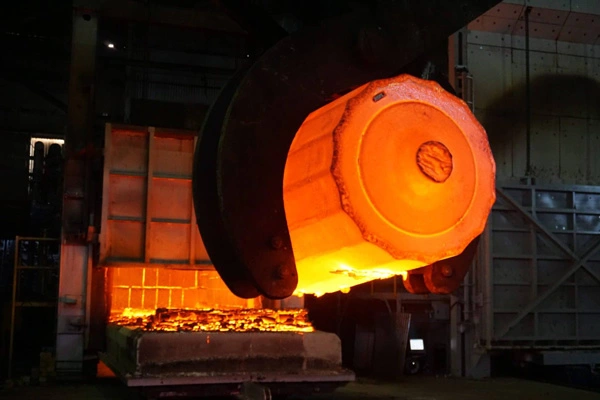
Hot forging is done after the heating of the metal to a very high temperature—so high that it makes the metal soft and easy to shape. This lowers the hardness, permitting profound deformation without cracking.
When the size, thickness, and complexity of the shape of your part design are pushed to the limit, you tend to prefer hot forging.
How Hot Forging Works
Metal billets or bars are first heated in a furnace until they are heated to the appropriate forging temperature. When they are ready, the operators hasten to put the metal into forging dies. The part is then shaped by application of control force by large presses or hammers.
Once the part has been made, it cools down. Due to the fact that cooling alerts dimensions marginally, most of the hot-forged components undergo clicking machining or heat treatment. The step assists in attaining final size, surface quality, and mechanical properties.
Key Benefits of Hot Forging
Hot forging has a number of valuable advantages:
- It is possible to create very complicated and dense forms.
- The metal flows readily in all corners of the die.
- Toughness and fatigue resistance are enhanced by alignment of the grains.
- Defects and internal voids decrease in the course of deformation.
Hot forging is typically suitable in the case of a flexible design and structure of your design.
Limitations of Hot Forging
Challenges will also be part and parcel of the hot forging:
- Cooling has an impact on dimensional accuracy
- Finish quality is decreased by surface oxidation.
- The furnaces raise the energy and operating expenses.
Due to these reasons hot forging may also need secondary operations.
Common Applications of Hot Forging
Hot forging will be applied to:
- Crankshafts and connecting rods.
- Large gears, shafts and axles.
- Parts of construction and mining equipment.
- Structural and load-bearing aerospace parts.
What is Cold Forging?
Cold forging consists of forming metal at room temperature. The process does not depend on heat but it uses very high pressure as the force that shapes the metal.
The cold forging is normally selected when precision repeatability and large volume efficiency are the most important factors.
How Cold Forging Works
The process of cold forming begins with wire rods or slugs of metal. The material is subsequently pushed by forging machines into highly machined dies. The metal does not shrink once it has been formed because it remains cool.
With this stability you are assured of the same dimensions, smooth surface, and repeatability when large production runs are involved.
Key Benefits of Cold Forging
Cold forging provides a number of strong advantages
- Strauss out of the die.
- Clean, smooth surface finish.
- Increased work hardening strength.
- Very little material waste.
Cold forging services work very well in providing near-net-shape parts at scale.
Limitations of Cold Forging
Cold forging is also limited in the following ways:
- Complicated or deep figures are complicated.
- There is high stress detected in tooling.
- Durability requires improved design of the process.
Due to this, cold forging is effective with less complicated geometries.
Common Applications of Cold Forging
Cold forging usually gives rise to:
- Nuts, bolts, screws, and fasteners.
- Small precision parts in the automotive sector.
- Electrical connectors and terminals.
- Hardware consumer and industry.
Hot Forging vs Cold Forging: Key Differences Explained
Temperature Difference
Hot forging involves the use of heat in order to soften metal. Cold forging involves pressure only. This variation influences the flow of metal, the preciousness of the part and the energy used up in the process.
Strength and Durability Comparison
Hot forging enhances impact resistance and toughness. Cold forging is the effect of enhancing tensile strength by work hardening. These two approaches result in powerful parts, yet they harden metal differently.
Precision and Surface Finish
Cold Forging provides smooth finishes and tight tolerances. Hot forging in most cases needs machining to the same degree of accuracy.
Cost and Production Efficiency
Hot forging is expensive per part because of heating and finishing. Cold forging is less expensive per part as the volume of production grows.
Material Waste and Sustainability
Cold forging yields little by way of scrap and endorses energy saving. Hot forging consumes more power and yet produces long-life components.
Hot Forging vs Cold Forging Comparison Table
| Feature | Hot Forging | Cold Forging |
| Temperature | Very high | Room temperature |
| Shape Complexity | Very high | Limited |
| Strength Type | Toughness | Tensile strength |
| Accuracy | Moderate | Very high |
| Surface Finish | Rough | Smooth |
| Production Volume | Low to medium | High |
| Waste Level | Moderate | Very low |
Which Forging Process is Better in 2026?
There’s no single winner. It is all about your application to make the better choice.
When Hot Forging is the Better Choice
Choose hot forging when:
- Your part is large or thick.
- Geometry is complex.
- The deformation is to be heavy.
- Hardiness is better than fineness.
When Cold Forging is the Better Choice
Choose cold forging when:
- Production volume is high.
- Close tolerances are of great importance.
- Finish on the surface should remain clean.
- Efficiency of the materials is important.
Cost Comparison: Hot Forging vs Cold Forging
Hot forging requires the use of furnaces, energy consumption, and finishing. These measures raise the unit costs. Cold forging involves greater investment in tooling at the expense of low cost in the long run due to a faster production process and centralized waste.
How complex, how much, and how finished your part is depends upon your total cost.
Environmental Impact: Hot Forging vs Cold Forging
Cold forging helps in sustainability initiatives, including minimizing energy use and scrap. Hot forging consumes more energy and creates parts that are highly durable and hence require less frequent replacement.
Industries Using Hot and Cold Forging in 2026
Instead, it is much more common to use hot and cold forging in industries in 2026.
The two processes are also vital:
- Automotive has engine applications as well as fastener applications.
- Aerospace uses hot forging as a basis of important strength.
- The reference is on hot-forged heavy constructions.
- Cold forging is required in electronics and hardware.
How to Choose Between Hot Forging and Cold Forging
You should ask yourself the following questions before making a decision:
- How difficult and big is your role?
- What kind of strength is required on your part?
- What quality of units are you going to manufacture?
- Tightness of tolerances?
- What do you want to spend on cost and energy?
The answer is clear, and it makes the decision so easy.
Future Trends in Forging Technology (2026 and Beyond)
Forging continues to evolve. The automation enhances uniformity. Low energy-consuming furnaces save costs. The hybrid forging is a combination of hot and cold processes that compromise on the strength and the precision.
Intelligent monitoring systems have assisted manufacturers in ensuring a consistent quality of production run.
Final Thoughts: Hot Forging vs. Cold Forging
Hot forging and cold forging have different manufacturing problems solved. One is flexible and tough, whereas the other is precise and efficient. The freedom of choice is based on your design, volume, and performance priorities.
We are manufacturers of forging solutions at HDC Manufacturing. We are concerned with quality, efficiency, and long-term performance. Our group collaborates closely with you in order to find the exact match of the forging process with your requirements. Need to produce in 2026, then get in touch with us today and we will develop the correct solution.
FAQs
1. Is hot forging stronger than cold forging?
Hot forging enhances toughness, whereas cold forging enhances tensile strength.
2. Which forging process costs less?
Cold forging is cheaper in high-volume production. Hot forging is appropriate for complicated parts.
3. Can one part use both processes?
Yes. Hot forging is applied to many parts and cold forging to many finishes.
4. Which metals work best for forging?
Depending on the process, steel, aluminum, copper, and most alloys are good.