When you look at the metal part in a machine, in an automobile, or even in a home appliance, you most likely do not consider the process of its manufacture. However, the manufacturing process is important. It has an influence on strength and cost, waste, and performance. This guide will explain the working of powder metallurgy and how it is better or worse than casting or forging in an easy-to-understand manner.
What is Powder Metallurgy?
Source: Blue Powder Metallurgy
This is a manufacturing process of metals in which you use finely grained metal powders rather than molten metal. You squeeze metal powder into a certain form and heat it in such a way that makes the particles be united. This heating process occurs at temperatures that are lower than the melting point of the metal.
Imagine that it is the construction of a sandcastle. You don’t melt the sand. You make it into form and leave it to hold. Powder metallurgy is similar but metal and precision are much better.
This process enables you to make compound forms of high tolerances. It also consumes very little materials and this makes it efficient and cost-effective for a variety of applications.
Types of Powder Metallurgy Processes
Although the overall concept, which is to heat metal dust, remains unchanged, we apply various recipes based on our self-needs.
Conventional Press and Sinter

It is the bread and butter of the industry. We put metal powder in, press it into a hard mold (a die), and press it with a huge hydraulic press. When it is a solid green piece, we push it through a furnace. It is ideal for producing thousands of gears and bushings in a short time.
Metal Injection Molding (MIM)
This is whereby metal dust is mixed with a plastic glue until it resembles modeling clay or toothpaste. We pour this mixture into a mold, as in the case of plastic toys. Then the glue is washed off and the metal is heated. This is the way we come up with some incredibly complicated forms, such as the small components of your smartphone.
Isostatic Pressing
It is not always sufficient to squeeze powder at the top and the bottom. Here we place the powder in a bag, which is very flexible and we submerge it under high-pressure water or gas. This acts on the metal in all directions simultaneously. It leaves behind a very dense and homogenous part.
Additive Manufacturing (3D Printing)
The high-tech future. A computer has been used to direct a laser or electronic beam over a metal powder bed. This is done by melting the dust into a thin film of solid metal and then applying another layer at the top with the laser. It enables us to create impossible forms that would have been impossible to create via the principle of a drill or a mold.
Raw Materials Used in Powder Metallurgy
You can’t just use any dust. Our recipe requires the flour to be of high quality. Common materials include:
- Iron and Steel: It is used in gears and as part of automobiles.
- Aluminum: The Ideal choice for lightweight parts.
- Copper and Bronze: These are the best to use in bearings, as they are able to absorb oil.
- Titanium: Aerospace and medical implants.
- Refractory Metals: Alloys such as Tungsten with extremely high-temperature melting points.
How Powder Metallurgy Works (Step by Step)
The production of a part by PM has its rhythm. Here is the breakdown:
Poder Production
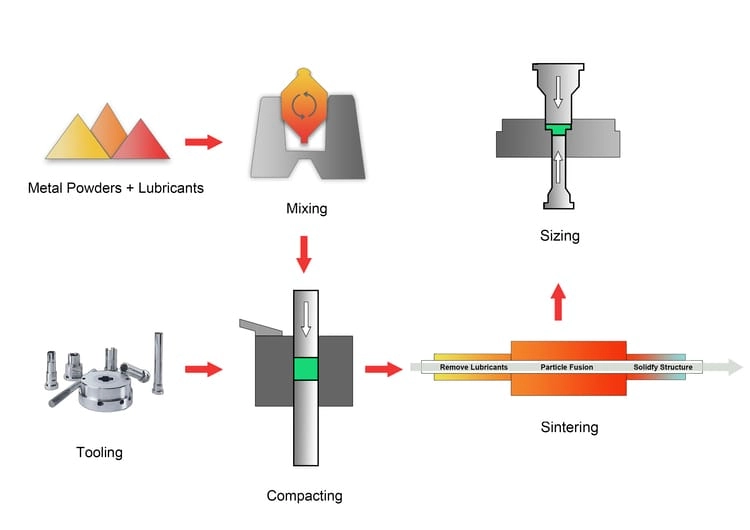
To begin with, solid metal is converted into powder. The most prevalent process is atomization, in which we spray melted metal using a nozzle that is under the pressure of air or water When the droplets become smaller, they are cooled into minute spheres.
Blending and Mixing
We do not use only one kind of powder. Different metals and lubricants are combined to make sure that the final component has the appropriate strength and that it will not be attached to the mold.
Compaction
We press the powder into a kind of mold and squeeze it under enormous pressure. At this step this portion is referred to as a green compact. It resembles the last section but it is out-of-week material; you can crack it with your fingers.
Sintering
This is the magic step. Green compact was put in a high-temperature furnace. The temperature is slightly lower than the melting point. The metal atoms are shaken and connected with each other, turning the weak dust into a solid and strong metal.
Secondary Operations
In some cases we make finishing touches. This may involve “infiltration” (stuffing up of pores with some other metals) or heating it to make it even harder.
Powder Metallurgy vs Casting vs Forging
What is Casting?
The art of casting is one of the most ancient methods of making it. Metal is melted down until it is a molten liquid and then poured into a hollow mold. As soon as it cools and hardens, the part is exposed by breaking the mold. It works well on large items such as engine blocks but it may result in air bubbles or scars.
What is Forging?
It is all about brute force in forging. You take a piece of metal, which is hard, and heat it till it is soft (but not liquid) and hammer or press it to shape. It is like playing with play dough, although it is a lot hotter and heavier. Forging renders the parts infinitely strong, and that is why it is applicable to such objects as crankshafts and hand tools.
| Feature | Powder Metallurgy | Casting | Forging |
| Material Waste | Very low (almost zero) | Moderate (Scrap out of gates/risers) | Huge |
| Complexity | High (Great when small, complicated parts) | Very High (Best in large and hollow parts) | Low (Reduced to more basic forms) |
| Strength | Good/Uniform | Variable (Can contain bubbles of air) | Highest (Medium grain structure) |
| Surface Finish | Smooth (Ready to use) | Rough sanding/polishing (Needs sanding polishing) | Moderate (Frequently requires machining) |
| Precision | Excellent | Fair | Moderate |
| Tooling Cost | High (Expensive dies) | Moderate (Molds very in cost) | High (Heavy duty equipment) |
| Production Speed | Very Fast (Mass production) | Slow (Waiting to have metal cooled) | Moderate |
| Special Feature | Self-Lubricating (Can hold oil) | Versatile Size | Extreme Durability |
Advantages of Powder Metallurgy Compared to Casting and Forging
Why do engineers choose the powder instead of the liquid metal or the hammers? Here are the big wins:
- No Waste (Green Manufacturing): There is always the need to machine the part in forging or casting, meaning to cut away chunks of metal to shape it correctly. Those shavings are wasted. In PM we consume nearly 97 percent of the raw powder. It will be more sustainable on the planet and less expensive at the factory.
- Unique Material Smoothing: There are some metals that are similar to oil and water; they do not desire to be mixed during the melting process. But when it comes to powder, we can make them a smoothie. We can add metals to ceramics or even add two metals that have very different melting points in order to form a superalloy.
- Porosity Control: It is a “superpower” of PM. It is possible to regulate the amount of small air bubbles left in the metal. When we abandon little pores. It is possible to impregnate the section with oil. In the meantime, you have a self-lubricating bearing that will remain oily for years without anyone having touched it.
- Consistency: Since the process is much more automated and accurate, the 1st part and 1,000,000th part will be the same. This degree of repeatability is critical to such industries as the car manufacturing industry.
Disadvantages of Powder Metallurgy
No process is perfect. The following is the reason why we do not use PM everywhere:
- Size Limits: Metal powder is extremely hard to squeeze. Having a press the size of a skyscraper would be required to make something the size of a car engine block. That is why the majority of PM parts are small; they usually weigh less than 5 pounds.
- Tooling Cost: The dies (molds) used to squeeze the powder are manufactured of very hard and expensive materials. Due to this initial expensive cost. PM will just be rational when you are producing thousands of parts. It does not work well preparing a single thing or two things.
- Strength Limits: PM parts are strong, but they are not subject to a grain flow as forged parts are. Forging is the sovereign of strength, yet in the case of what must endure extreme violence, as a hammerhead or the drive shaft of a tank, forging is the king of strength.
Applications of Powder Metallurgy
Every day you are surrounded by PM parts! Here is where they hide:
- Cars: Cars have a powerful engine and have power-connected rods and timing gears. Even the metallic brake pads that assist you to stop are usually made using PM techniques.
- Home & Kitchen: Go and look at your power drill. The problem of high-speed and heat gears in the interior is nearly definitely PM products. Even in some of the priciest kitchen knives, they utilize the powder steel in order to make the edge last longer.
- Medicine: PM has been used by surgeons to produce parts that are biocompatible. The reason why titanium hip replacements are often made or why dental implants can be made this way is because the metal can be designed with a slight porosity, which allows your real bone to grow into the metal and hold it.
- Technology: The little vibration motor in your phone that makes you feel that your phone is vibrating in your pocket uses high-density PM weights. Copper powders are also commonly used to create heat sinks that ensure your computer CPU is not melted down.
When to Use Powder Metallurgy Instead of Casting or Forging
The selection of the appropriate method is comparable to the selection of the appropriate tool used in a job. Use PM if:
- High Precision is Key: In case your part has to be within a few microns of a human hair and no additional sanding or cutting is required.
- Massive Volume: In case you require the production of 50,000-100,000 units. The more the machine runs at speed, the cheaper each part will be.
- Complex Geometry: In case your component has holes or has odd angles on internal gears in it, which would be a nightmare to cut in a solid block.
- Hard Materials: When dealing with hard materials such as a Tungsten (whose melting point is so high that it would melt most casting molds).
Future Trends in Powder Metallurgy
What’s next for this industry?
- Metal 3D Printing at Scale: 3D printing is currently low. However, tens of metal components can now be printed simultaneously with new technology called binder jetting, which opens up the possibilities of PM with the forms of 3D design.
- Smart Powders: Scientists are coming up with powders that have the capability of detecting stress. Suppose a bridge or an airplane component created out of metal is capable of communicating to a computer once it is going to crack prior to its eventual occurrence.
- Sustainability: PM also consumes less energy than liquid netal meltdown and therefore more companies are moving to PM in order to achieve net zero carbon targets.
Conclusion
Powder metallurgy is a real secret of today’s engineering. It is the transition between the ancient and high-tech world of metalworking and its modern application. We can now make more efficient, less wasteful, and more complex machines than at any point in time by reducing metal into dust and returning it to solid form.
We are the top leaders in these manufacturing technologies at HDC. You need an extra automotive part or an ultra-sensitive technology device; at any rate, our specialized team is always available to review every cost-effective and long-lasting approach with you
We welcome you to contact us to become our new clients. Let’s talk about the ways of how we can make your next big idea come true with accuracy and attention to detail. Call HDC now and get a free quote.
FAQs
Is powder Metallurgy stronger than casting?
Generally, yes. The PM parts are also more uniform and have fewer internal holes as compared to cast parts but tend to be weaker than the forged parts.
What is the most common metal used in powder metallurgy?
The most common ones are iron and alloys made of iron since they are cheap and are highly powerful in automotive and industrial applications.
Can PM replace forging?
In some cases, yes! Particularly in small, intricate components in which the sinter-forging (hybrid process) offers sufficient strength and the traditional forging
Is powder metallurgy expensive?
With small amounts, yes, as the molds are expensive. It is, however, the cheapest in the case of large-volume production, as it does not require additional labor and machining.
Does powder metallurgy rust?
It’s just like any metal; it relies on the material. Stainless steel powder will not rust. In the case of iron, it may be required that you plate or coat the part.