Moving heavy objects is not an easy task; however, with the help of such simple machines as a pulley, this task becomes much easier. Pulleys are common in the simplest domestic tools and the large industrial systems. They can be seen as simple but they are meant to lessen the work and enhance efficiency in the transportation of loads.
This guide will help you understand what a pulley is and how it works, its various types, the applications it usually finds, the ways of making it and most importantly, the cost-effective methods of casting it.
1. What is a Pulley?
Rolle is a simple mechanical device comprising a wheel with a groove around the edge. This groove has a rope, cable or belt that will be used to lift or move loads. With the help of a pulley, you will not need to use as much force as you would otherwise use. You can pull downwards or in a different direction than lifting something straight up and this will make the job easier.
Basic Parts of a Pulley
In order to get any more ideas about it, the following are the key sections:
- Wheel (Sheave): The rotating round. The diameter of the sheave is very important in specifying the mechanical advantage in an industrial setting.
- Groove: This is the channel in which the rope or belt is located. This makes the cable not slip off when in use.
- Achse: This is the center where the wheel rotates in high quality pulleys bearings are often used in order to minimize friction.
- Rope or Belt: This is the way in which the things are lifted or moved.
2. How Does a Pulley Work?
A pulley operates under the principle of altering the direction of force and minimizing the input of effort to raise heavy objects. To illustrate this point, to hoist a heavy box straight up, it takes a lot of strength. However, when you operate using a pulley, you can draw the rope downwards and the box will ascend. This will enable you to use your personal body weight to assist you with the lift.
Key Working Principle: Mechanical Advantages
Mechanical advantage is the principle of the pulley. It is a ratio of the force amplification through the use of a tool.
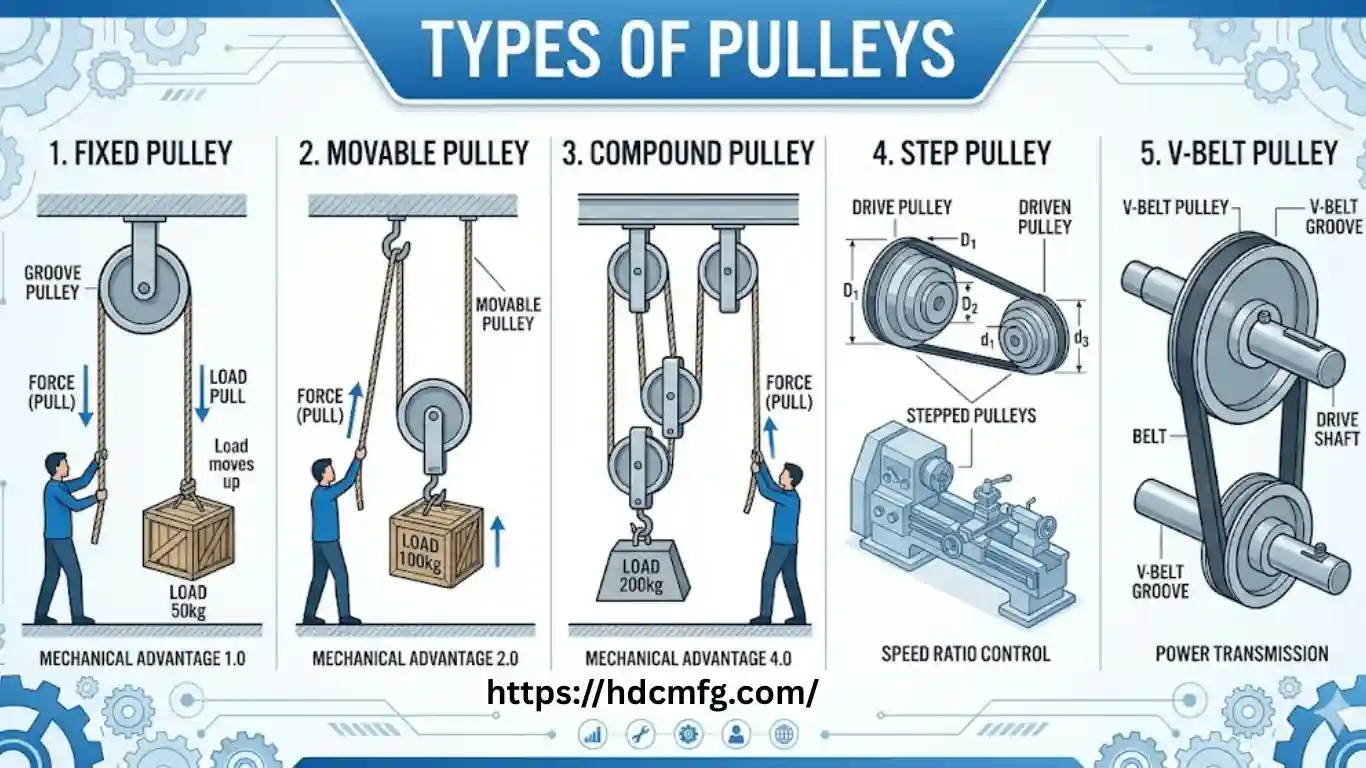
- Single Fixed Pulley: Reverses the direction of force but with a mechanical advantage of 1 (you still pull with the same weight as the object).
- Movable or Compound Pulleys: This is a system that spreads the weight over several lengths of rope; in effect, it decreases the amount of effort required to raise the weight.
Real Life Example: Consider a construction crane. A pulley system (also known as a block and tackle) is used by workers to hoist heavy steel beams. Without such a system, the motors necessary to move such weight would have to be huge and inefficient.
3. Main Functions of a Pulley
A pulley is not exclusively used to lift. It has a number of significant roles in systems and machines.
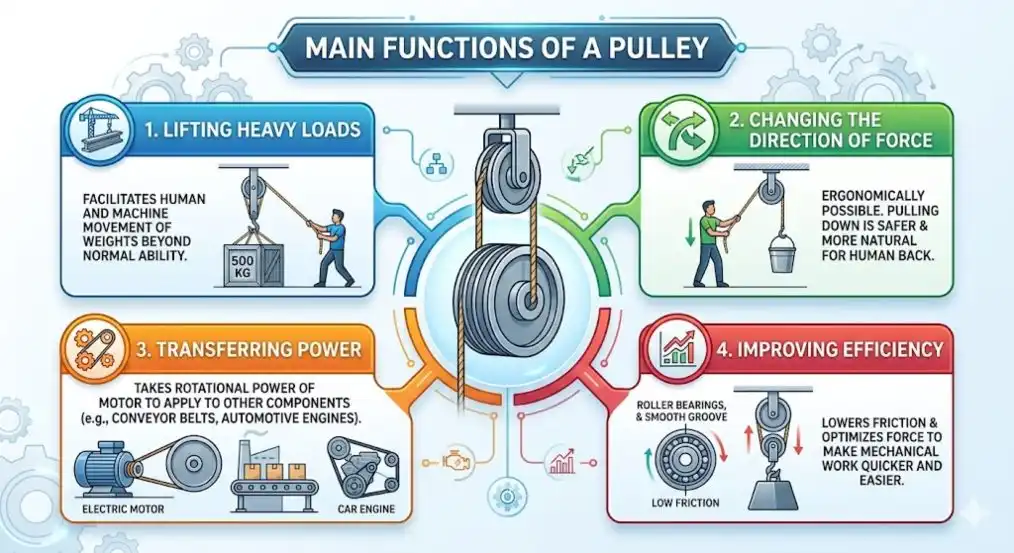
- Lifting Heavy Loads: The major role, which facilitates human and machine movement of weights way beyond the normal ability, is aided by lifting heavy loads.
- Changing the Direction of Force: Is ergonomically possible. Pulling up is usually more dangerous and painful to the human back compared to pulling down.
- Transferring Power: Shopping carts and conveyor belts used in the factory or automotive engines use pulleys to take the rotational power of the motor and apply it to other components.
- Improving Efficiency: Pulleys lower the friction and optimize the force to make mechanical work quicker and easier.
4. Types of Pulleys
Various types of pulleys are needed in different tasks. The selection of the appropriate type is determined by whether you have to alter the direction of a pull or increase the force you are applying.
Fixed Pulley
A fixed pulley is mounted on a fixed structure, e.g., a beam or ceiling and does not move with the load.
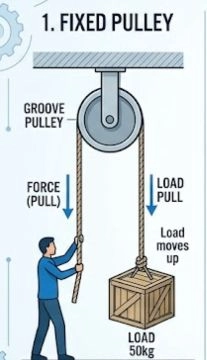
- Mechanical Advantages: Das MA is 1. This simplifies it: when you are pulling a 50 kg weight, you have to pull a 50 kg weight.
- Role: It is mostly used to alter the course of force.
- Industrial Application: Flagpoles, wells and window blinds. It also enables a worker to utilize his or her body weight to lift downwards, which is far safer and more ergonomic than lifting upwards.
Movable Pulley
In this arrangement, one end of the rope is attached to the support and the pulley, together with the load, moves.
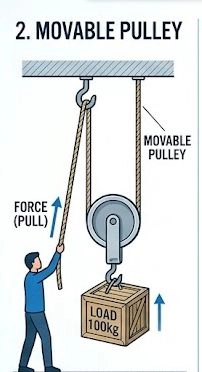
- Mechanical Advantages: Das MA is 2. Since the load is carried by two pieces of ropes, the work involved is reduced by half.
- Role: To reduce the amount of input force needed.
- Industrial Application: Commonly applied in construction hoists of heavy duty. Although it reduces the weight of the load, you have to drag twice the distance with the rope to move the load a distance.
Compound Pulley
The compound pulley is a complex apparatus that integrates both fixed and mobile pulleys on the same rig.
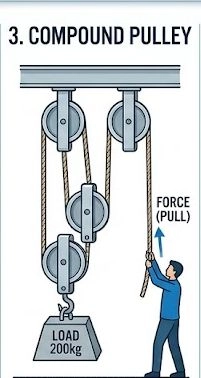
- Mechanical Advantages: MA is normal or more, depending on the number of loops of ropes (sheaves).
- Role: To achieve the highest mechanical advantage on very heavy weights.
- Industrial Application: This is the standard of overhead cranes. Ship rigging and engine hoist. It enables one operator or a motor of a small size to lift material of several tons by spreading the load among many pulleys.
Step Pulley
A step pulley is a combination of a number of pulleys (steps) of varying diameters mounted on one rotating shaft.
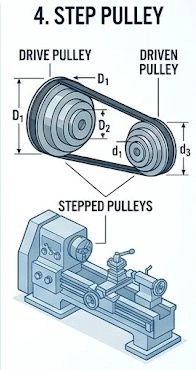
- Role: It is used in speed and torque control.
- Vorteile: The ability to adjust the speed of a machine by changing the size of the step of the belt rather than having to purchase a costly electronic speed controller.
- Industrial Application: It is necessary in workshop equipment such as drill presses, lathes and milling machines, where varying materials (such as wood vs. Steel) have varying drilling speeds.
V-Belt Pulley
These pulleys are specifically designed to have a deep V groove. Which is designed to fit rubber V-belts of the same shape.
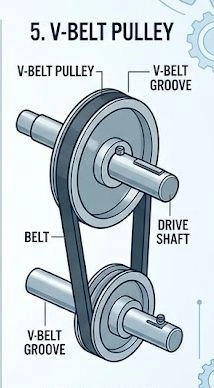
- Role: Power transmission of high efficiency.
- Vorteile: The belt is wedge-shaped and thus generates a lot of friction on the walls of the pulleys. This gives a very good grip; thus, the belt does not slip even when starting at high torque.
- Industrial Application: This is commonly used in automotive engines (alternators/pumps) and heavy industry fans or compressors where the delivery of power is essential.
Quick Summery Table on Types of Pulleys
| Pulley Type | Hauptvorteil | Typical MA | Bester Anwendungsfall |
| Fixed | Changes direction | 1 | Flagpoles / Wells |
| Movable | Reduces effort | 2 | Construction hoists |
| Compound | Heavy lifting | 2+ | Cranes / Shipping |
| Schritt | Adjusts speed | Variable | Lathes / Drills |
| V-Belt | Prevents slip | N / A | Car engines / Pumps |
5. Common Applications of Pulleys
- Baugewerbe: This is a necessity to have cranes and lifting rigs to transport concrete, steel, and machinery.
- Elevators: Elevators are a complicated system of pulleys and counterweights that enable the lifts to move up and down between the floors.
- Gym Equipment: Gym equipment involves the use of pulleys to deliver a steady resistance during a series of movements.
- Industrielle Maschinen: Conveyor belts used in packaging plants are dependent on pulleys to ensure that products are in motion.
- Automobil Systems: Timing belts, fan belts, and alternators are all based on the pulley system to operate properly.
6. Verwendete Materialien in Pulley Manufacturing
The choice of material is based on the surrounding environment and the load capacity, which is necessary:
- Cast Iron: The standard of the industry. It is extremely powerful, has natural lubrication as it contains graphite and is quite economical.
- Steel: It is employed in heavy loads with high stress conditions where it is necessary to have extreme tensile strength.
- Aluminium: It is used in lightweight applications or in cases where corrosion-resistant properties are required (such as marine environments).
- Plastic / Nylon: Suited for light-duty household use where low noise and low cost are the considerations.
7. How Pulleys are Manufactured
The production of a pulley has to be very accurate so that it becomes balanced and will not vibrate at high velocities.
Overview of Pulley Fabrication
- Materialauswahl: Selecting the appropriate alloy of use.
- Shaping: This is the formation of the original shape through casting or forging.
- Bearbeitung: The dimensions are refined, in particular, the groove and the hole in the axle.
- Qualitätskontrolle: Inspection of balance and surface defects.
Casting: The Most Common and Cost-Effective Method
The process of pouring molten metal into a mold is known as casting. It is the favorite one that is used in large-scale production.
- So funktioniert es: Metal is melted, poured into a sand or investment mold, cooled and removed.
- Why It Is Preferred: It can be made of complex internal geometries (such as spokes) and it generates very minimal material wastage as compared to cutting a pulley out of a solid block of metal.
Bearbeitungsprozess
Once a pulley has been cast, it is put on a lathe. The pulley is rotated at great speeds on the lathe and is smoothed by cutting tools; the groove is centered to a perfect center and the center hole is drilled to the millimeter. This is essential in order to avoid wobbling when in operation.
Forging (Less Common)
Forging is done by beating or pressing metal into form when hot. This produces an extraordinarily high internal grain structure and is far more costly and typically only used in special aerospace or heavy-duty mining pulleys.
Fabrication/Welding
This consists of cutting individual plates and tubes and welding them. It is primarily applied to huge, exceptional custom pulleys in which forming a casting mold would be prohibitively costly.
8. Why Casting is Preferred for Pulley Manufacturing
- Kosteneffizienz: Reduction in labor costs and reuse of molds.
- Easy Mass Production: It is possible to manufacture thousands of the same pulley in one day.
- Designflexibilität: It is easy to produce lightweight spoked pulleys by casting, which are strong without excess weight.
- Good Strength: Cast iron is inherently wear resistant and is able to withstand the friction of a belt.
9. Advantages and Disadvantages of Pulleys
Pros of Pulleys
- Lessens physical work and stress.
- Minimal design, which has few moving parts, resulting in a long life.
- Low maintenance requirements.
- Improves the safety by relocating the operator to a safe distance.
Cons of Pulleys
- Friction: This is a loss of energy in the form of heat due to the movement of the rope and the wheel.
- Verschleiß: Ropes and belts are ultimately frayed and have to be replaced.
- Ausrichtung: In case pulleys are not aligned, belts slip or break.
10. Conclusion
A pulley is a very simple but efficient mechanical machine that simplifies lifting and moving loads significantly. Simple mechanisms like pulleys are used in the enhancement of efficiency and effort reduction even in complex industrial machines.
Im HDC-Herstellung, we are concentrated on the production of high-quality pulleys according to the modern industry requirements. Our casting Pulley processes are highly sophisticated, using techniques that guarantee durability, precision and low costs. Whether you have a V-belt or some custom industrial sheaves to make, we offer you the best manufacturing support in order to make your projects run. Get in touch with us to find out what you need.
FAQs About Pulleys
What is a Pulley in simple words?
It is a grooved wheel that is used with a rope or a belt to ease the process of lifting things.
What are the main types of pulleys?
Fixed, movable, compound (block and tackle) step and V-belt pulleys.
How does a pulley reduce effort?
It relies on mechanical advantage, distributing the weight of the load over several sections of rope and thus you use less force to pull.
Which material is best for pulleys?
Most industries can use cast iron because it is strong and cheap.
Why is casting used in pulley manufacturing?
It is the most effective method of manufacturing complicated, robust, and balanced wheels on a large scale.