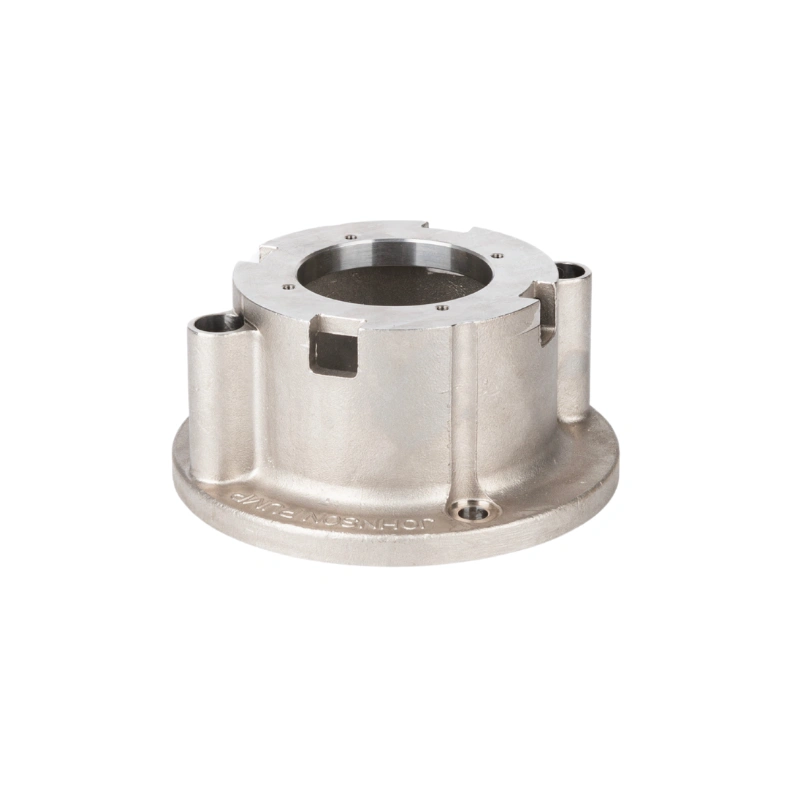
The silica sol vs water glass decision is mainly about the ceramic shell used in investment casting. Both materials bind refractory particles around a wax pattern, but they do not produce the same process economics or casting quality. Silica sol is usually selected when surface finish, dimensional control, fine detail, and reduced post-processing matter. Water glass is normally chosen when cost, larger part size, and acceptable rather than exceptional as-cast precision are the main priorities. Neither process is universally better. The right choice depends on the drawing, alloy, annual quantity, machining plan, and total delivered cost.
What Is the Difference Between Silica Sol and Water Glass?
Silica sol and water glass are both silica-based materials, but their physical and chemical forms are different.
Silica sol, also called colloidal silica, is a stable suspension of extremely small amorphous silica particles in water. The particles remain separated because of their surface charge. As water is removed during shell drying, the particles move closer together and create a silica network that binds the refractory grains. The Investment Casting Institute’s technical overview of colloidal silica explains that investment-casting grades are produced with controlled particle sizes and distributions because those characteristics affect binder behavior.
Water glass is an aqueous sodium silicate solution. Rather than containing separate colloidal particles in the same form as silica sol, it contains soluble alkaline silicate species. In investment casting, the sodium silicate binder is hardened or gelled to hold the refractory shell together. The exact hardening chemistry and shell-building procedure vary between foundries.
The two materials are chemically related. Industrial colloidal silica has traditionally been manufactured from sodium silicate by removing much of the sodium and then growing controlled silica particles. However, the final binders behave differently in slurry preparation, hardening, drying, shell performance, and casting production.
How Both Binders Work in Investment Casting
The basic casting route remains lost-wax investment casting in both cases. Wax patterns are produced and assembled onto a runner system. The assembly is repeatedly dipped into ceramic slurry and coated with refractory stucco until the shell reaches the required thickness. The wax is then removed, the shell is fired, molten metal is poured, and the ceramic is broken away after solidification.
The binder is what holds the refractory flour and stucco together during shell building, dewaxing, firing, and pouring. It must provide enough green strength for handling and dewaxing, enough fired strength to withstand molten metal, and enough permeability for gases to escape.
With silica sol, shell development depends heavily on controlled slurry stability and intercoat drying. With water glass, chemical hardening is commonly used to develop shell strength more quickly. This difference helps explain why water glass is often associated with lower-cost production, while silica sol is more closely associated with precision shell casting.
Silica Sol vs Water Glass at a Glance
| Decision factor | Silica sol investment casting | Water glass investment casting |
| Binder form | Colloidal silica particles suspended in water | Soluble sodium silicate solution |
| Main commercial priority | Precision, finish, detail, consistency | Lower process cost and practical production |
| As-cast surface | Generally finer and cleaner | Generally rougher than silica-sol casting |
| Dimensional control | Usually better for complex precision parts | Suitable for moderate as-cast requirements |
| Shell production | Relies strongly on controlled drying | Commonly uses chemical hardening |
| Typical project fit | Smaller or medium precision components | Medium or larger functional components |
| Process cost | Higher shell-system and control cost | Lower binder and shell-production cost |
| Machining requirement | Often lower, but functional features still need machining | More likely to need added stock and cleanup |
| Best buying logic | Minimize downstream work and quality risk | Minimize casting cost where machining is already planned |
These are practical process tendencies, not universal guarantees. Wax quality, refractory selection, shell-room control, alloy, geometry, and foundry experience can move the actual result significantly.
Surface Finish: Where Silica Sol Usually Has the Advantage
Surface finish is one of the clearest reasons to choose silica sol investment casting. The fine colloidal binder supports a controlled prime-coat system that can reproduce wax detail with less surface disruption. The result is normally a smoother casting skin, sharper small features, and less grinding or cosmetic cleanup.
This matters even when the component is not decorative. A cleaner surface makes inspection easier and can reduce uncertainty around shallow markings, thin edges, fillets, and cast lettering. It can also reduce the amount of stock that must be removed before coating, polishing, or assembly.
Water glass casting can still produce a much better surface than conventional sand casting. It is a valid investment-casting route, not a rough-casting substitute. However, it is usually chosen where the required surface quality is functional rather than premium. If most important faces will be CNC machined anyway, paying for the finest possible as-cast finish may not improve the final part enough to justify the premium.
Dimensional Accuracy and Repeatability
Silica sol normally provides the stronger starting point when a buyer wants tighter as-cast dimensions. Its shell-building system is well suited to precision parts with small features, curved profiles, and geometry that would otherwise require extensive machining.
That does not mean the binder alone determines tolerance. Wax injection variation, pattern storage, tree assembly, shell thickness, dewaxing, firing, alloy shrinkage, and heat treatment all affect the final dimensions. A silica-sol shell cannot compensate for poor wax tooling or inconsistent process control.
Water glass casting is usually more appropriate when the drawing allows wider as-cast tolerances or when the supplier will machine the critical features afterward. It can be commercially effective for brackets, levers, agricultural components, construction hardware, and industrial steel parts where overall geometry is important but bearing seats, holes, threads, and sealing faces will be finished separately.
For buyers, the real decision is not whether one process is “accurate” and the other is “inaccurate.” It is whether the as-cast accuracy of water glass is sufficient for the machining plan. When it is, water glass can produce a lower total cost. When it is not, silica sol may prevent costly rework and excessive stock removal.
Shell Strength, Drying, and Process Stability
Silica-sol shell systems require disciplined slurry and drying control. The Investment Casting Institute’s slurry-analysis guidance identifies binder solids, pH, slurry temperature, viscosity, density, refractory content, and biological contamination as important control variables.
This level of control is necessary because colloidal silica depends on particle stability. Contamination, unsuitable water, pH drift, or concentration changes can cause particle agglomeration or premature gelation. Once that happens, effective silica surface area falls and shell properties become less predictable.
Water glass also requires process control, but the control points are different. The foundry must manage sodium silicate concentration, silica-to-sodium ratio, slurry condition, hardener strength, hardening time, shell thickness, and residual chemicals. An overly aggressive hardening cycle can produce brittle or inconsistent shells. Poor rinsing or process control can also create surface and environmental problems.
A buyer does not need to audit every chemical parameter. However, a serious supplier should be able to explain how slurry condition, shell strength, drying or hardening, and shell defects are monitored. The binder name alone is not evidence of a controlled process.
Cost: Compare the Finished Part, Not Only the Shell
Water glass casting usually has the lower direct shell-production cost. The binder is economical, shell hardening can be relatively fast, and the route is widely used for price-sensitive steel castings. This makes it attractive when quantities are substantial and the drawing does not demand premium as-cast finish.
Silica sol costs more because the binder system, refractory package, drying time, shell-room control, and production cycle are generally more demanding. However, the higher casting price may be offset by lower grinding, reduced machining allowance, fewer cosmetic rejects, and better dimensional consistency.
Consider a component with five machined faces, several drilled holes, and no visible as-cast surfaces. Water glass may be entirely adequate because most functional geometry will be created during CNC machining. Paying more for silica sol may offer limited benefit.
Now consider a stainless valve component with thin sections, curved passages, cast markings, and several surfaces that will remain as-cast. Silica sol may reduce machining, improve inspection confidence, and lower rejection risk. In that case, the higher casting price can produce the lower delivered-part cost.
The correct comparison should include tooling, wax patterns, shell production, metal yield, grinding, CNC time, tooling wear, inspection, scrap risk, finishing, and lead time.
Which Materials Can Be Cast With Each Process?
Both binder systems can be used with several steel and non-ferrous alloy families. The choice is not controlled by alloy alone.
Water glass investment casting is commonly associated with carbon steel and low-alloy steel parts where cost and mechanical function take priority over the finest surface. It is often suitable for robust industrial components that will receive machining or coating after casting.
Silica sol is commonly selected for stainless steel, heat-resistant steels, nickel alloys, carbon and alloy steels, and other materials used in precision components. It is particularly useful when the alloy is expensive and near-net casting can reduce the amount of material removed during machining.
The foundry must still match the face-coat refractory, shell composition, firing schedule, and pouring practice to the alloy. A binder that performs well in one shell formulation does not automatically suit every metal and pouring temperature.
Part Size and Geometry
Silica sol is usually the better route for small to medium parts with detailed geometry, thin sections, fine lettering, complex contours, and a high proportion of surfaces that must remain as-cast. It is also valuable where multiple small components are assembled efficiently on a casting tree.
Water glass often becomes attractive as parts become heavier, more robust, or less dependent on fine detail. The process can bridge the commercial gap between sand casting and high-precision silica-sol investment casting. It offers more shape freedom and a better surface than sand casting while avoiding some of the cost associated with a full silica-sol shell system.
Part weight alone should not decide the process. A large part with strict surface and dimensional requirements may still justify silica sol. A small but heavily machined part may remain economical with water glass. The percentage of the component that must remain as-cast is often a better decision factor than size by itself.
How the Binder Choice Affects CNC Machining
A casting buyer should think about the binder and the machining plan together.
Silica sol can reduce the starting surface variation and allow a more controlled machining allowance. That may shorten roughing cycles and reduce the chance that machining fails to clean up a surface. It is useful where a casting contains thin flanges, tight stock conditions, or nearby as-cast geometry that limits how much material can be removed.
Water glass castings commonly need more conservative machining allowance. That is not necessarily a disadvantage if machining was already planned. A larger allowance can provide useful protection against as-cast variation, but it increases cycle time, material removal, and tool use.
Neither process should be expected to hold final bearing fits, sealing faces, precision threads, or tightly related datum structures directly from casting. Those features are generally better handled by CNC machining. The buyer should define which dimensions are as-cast and which are machined before requesting quotations.
How to Choose Between Silica Sol and Water Glass
Silica sol is usually the stronger choice when the part has strict as-cast surface requirements, fine geometry, thinner sections, expensive alloy, reduced machining targets, or a high cost of rejection. It is also appropriate when appearance and consistency must remain stable across batches.
Water glass is usually the better commercial choice when the part is mechanically robust, cost-sensitive, moderate in tolerance, and already scheduled for substantial machining. It is particularly useful when the buyer needs more complexity and better finish than sand casting can offer but does not need the full precision of silica sol.
The process should not be selected only from a 3D model. The drawing, alloy, annual quantity, machined datums, critical surfaces, pressure requirements, inspection plan, and acceptable repair policy all affect the answer.
What to Put in an RFQ
A useful RFQ should state the preferred alloy, expected annual quantity, part weight, and required inspection level. It should clearly identify which surfaces will remain as-cast and which will be machined. Surface finish expectations should be stated where they matter rather than applied blindly to the entire component.
Buyers should also identify sealing zones, pressure-containing areas, fatigue-critical sections, and any features that must machine clean without opening porosity or inclusions. The supplier can then recommend silica sol, water glass, or another casting route based on total manufacturing risk.
It is better to ask the foundry for its normal as-cast capability for the proposed process than to impose a tolerance copied from a generic chart. A realistic process capability supported by first-article inspection is more useful than an aggressive drawing note that simply increases the quote.
Where HDC Manufacturing Fits
HDC supports buyers who need precision investment castings as well as broader custom casting solutions. Through its investment casting service, HDC can review part geometry, alloy, as-cast requirements, and production quantity before recommending the shell and manufacturing route.
HDC also provides CNC finishing when the drawing includes strict bores, threads, sealing faces, or datum relationships. This integrated approach is important because binder selection should support the finished component, not become an isolated foundry decision. Buyers evaluating several manufacturing routes can also use HDC’s broader metal casting service to compare investment casting with sand casting, die casting, or another suitable process.
Frequently Asked Questions
Can water glass casting be used for stainless steel parts?
Yes. Water glass can be used for stainless and other steel castings. The more important question is whether its normal surface finish, tolerance capability, and machining allowance suit the drawing.
Is silica sol always worth the extra cost?
No. It adds the most value when better as-cast finish, tighter dimensional control, fine detail, or reduced machining will lower total cost. For heavily machined parts with moderate requirements, water glass may be more economical.
Can a supplier use silica sol only on the first shell layer?
Some foundries develop mixed or hybrid shell strategies to balance prime-coat quality with backup-shell cost. The buyer should evaluate the demonstrated casting result rather than assuming the binder name alone guarantees a specific tolerance or finish.
Which process is better for pressure-containing parts?
Binder selection alone does not establish pressure integrity. Alloy quality, gating, feeding, shell control, porosity, heat treatment, machining, and pressure testing all matter. Silica sol may provide a cleaner precision route, but the acceptance plan must still address the pressure-critical zones.
What evidence should a supplier provide before production?
A first-article dimensional report, material certification, surface and visual inspection results, and any required NDT or pressure-test records are more useful than a general claim that the part is “precision cast.”
Conclusion
The silica sol vs water glass choice should be based on the finished part, not the binder price alone. Silica sol usually offers better surface finish, dimensional consistency, and fine-detail capability, but it requires more process control and normally costs more. Water glass offers a practical, lower-cost investment-casting route for robust parts with moderate as-cast requirements. Buyers should compare casting cost, machining allowance, cleanup, inspection, and rejection risk together. The best process is the one that meets the drawing at the lowest reliable delivered cost.